



Selenite Chakra Athame (10″)
$24.15
A Moonstone Blade for Cleansing
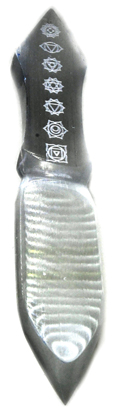
A carved selenite athame with chakra symbols on the handle, reached for when you want a blade of pure moonlit stone for clearing and blessing.
Quick Uses
- Aura Sweep: Draw it slowly down the body a few inches away to clear what clings to you.
- Tool Clearing: Lay other tools and stones beside it overnight to refresh them.
- Lunar Circle: Cast your circle with it at the full moon for a clear, bright working space.
How to Use It
Witchcraft & Folk Magick
- Use it to cast a circle for lunar rites, moon water work and esbats.
- Sweep it over your altar before a ritual to clear the residue of past workings.
Ceremonial & Occult Magick
- Use it as a blade of the Moon in rituals of Yesod and lunar talismans.
- Point it at each of the seven chakra points along the body while naming the planets in turn, in a Middle Pillar style exercise.
Demonology & Black Magick
- Sweep yourself with it after evocation or spirit work to cut away lingering attachments.
- Lay it across the threshold of the temple to keep the space clean between workings.
A Simple Working
- On a Monday night, set it on a white cloth near a window with the moon visible.
- Light a white chime candle beside it.
- Hold the athame by its carved handle and draw it slowly from crown to feet, a hand’s width from the body.
- With each pass, name what you are clearing away.
- Trace a circle around yourself with the point to close the clearing.
- Leave the blade by the window overnight to rest in the moonlight.
Pairs Well With
- White Chime Candles: For lunar and cleansing work.
- Selenite Charging Plate: To keep the athame and other stones clear.
- White Sage or Rosemary: For smoke cleansing before the working.
- Moonstone: A lunar stone to keep with the blade.
What You Receive
One 10″ selenite athame with chakra symbols carved on the handle. Natural stone, so size, shape, lines and inclusions vary slightly from piece to piece.
Origin & Lore
The athame is the witch’s ritual knife, traditionally used to cast the circle, direct will and command the elements rather than to cut anything physical. A stone blade like this is made for energetic work: clearing, blessing and directing, never cutting.
Selenite is a clear crystalline form of gypsum, named from the Greek Selene, the Moon, for its soft pearly sheen. The idea of chakras comes from Indian tantric yoga, and the familiar system of seven rainbow-coloured chakras was popularised in Western esoteric circles in the twentieth century.
Did You Know?
Selenite takes its name from Selene, the Greek goddess of the Moon, for its soft moonlike glow.
Related products


