


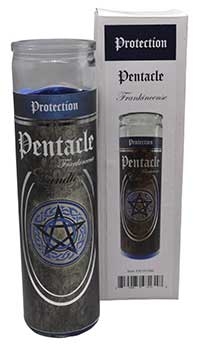
Pentacle 90-hour jar candle (frankincense)
$16.45
A frankincense flame for consecration
A frankincense-scented 90-hour jar candle with pentacle artwork, burned for protection, consecration and clearing a ritual space.
Quick Uses
- Consecration: pass new tools, jewellery or altar pieces over the lit candle and name what each is for.
- Altar: keep it burning at the northern quarter through a full sabbat or esbat.
- Clearing: burn it in a room for several hours after a move, a quarrel or an unwelcome guest.
- Solar hour: begin consecrations on a Sunday in the planetary hour of the Sun.
How to Use It
Witchcraft & Folk Magick
- Consecration: pass new tools, jewellery or altar pieces over the lit candle and name what each is for.
- Altar light: keep it burning at the northern quarter of the altar through a full sabbat or esbat.
- Clearing: burn it in a room for several hours after a move, a quarrel or an unwelcome guest.
Ceremonial & Occult Magick
- Pentagram ritual: light it before the Lesser Banishing Ritual of the Pentagram so the space is held as you work.
- Solar hour: frankincense belongs to the Sun, and many magicians start consecrations on a Sunday in the planetary hour of the Sun.
A Simple Working
- Set the candle at the centre of a table with the tool or object you want to consecrate in front of it.
- Light a disc of charcoal and drop a few frankincense tears onto it.
- Light the candle and trace a pentagram in the air above it.
- Pass the object through the smoke, then hold it near the flame.
- Say what the object is now dedicated to.
- Let the candle burn while the resin smokes out, then snuff and relight as needed.
Pairs Well With
- Frankincense tears: to burn alongside the candle on charcoal.
- A pentacle altar tile: to hold the jar during the burn.
- Sea salt: to sprinkle around the object for full consecration.
- Charcoal tablets: to burn the resin on.
What You Receive
One frankincense-scented jar candle with pentacle artwork, approximately 90 hours of burn time, supplied boxed.
Origin & Lore
The pentacle, a five-pointed star in a circle, is the sign of earth on the Wiccan altar and the emblem of protection in modern witchcraft, each point standing for an element and the topmost for spirit. Frankincense, the scent chosen here, has been burned in temples and churches for thousands of years to purify a space and carry prayers upward. Together they make a candle for the working altar.
The Pythagoreans used the five-pointed star as their secret sign of recognition, and wrote around it the Greek word for health.
Greek writers including Lucian record that the Pythagoreans used the pentagram as a mark of fellowship and associated it with health, with the letters of hygieia, “health”, later placed at its points. In Renaissance grimoires such as the Key of Solomon, “pentacle” meant any consecrated disc carrying protective names and seals, not only the five-pointed star. Wicca made the star-in-circle the central altar pentacle in the 20th century.
Did You Know?
In 2007 the US Department of Veterans Affairs approved the pentacle as an emblem of belief for veterans’ headstones.
| Weight | 1.8 lbs |
|---|
Related products


