


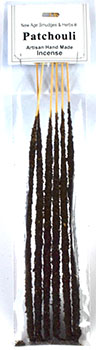

Patchouli incense sticks
Price range: $1.93 through $9.85
Earthy smoke for money and grounding · Available in 3 sizes
Patchouli sticks with a rich, earthy, musky smoke, burned for money, attraction and grounding.
Quick Uses
- Money: burn a stick during a green candle working, or on Saturdays for steady, slow gains.
- Grounding: burn one after ritual to bring yourself back down to earth.
- Money drawing: smoke money mojo bags and dressed dollar bills over a lit stick.
- Love: burn it during love and lust work to add earthy attraction.
How to Use It
Witchcraft & Folk Magick
- Money: burn during a green candle working, or on Saturdays for steady, slow gains.
- Grounding: burn after ritual to bring yourself back down to earth.
- Sensual mood: burn in the bedroom before a lover arrives.
Hoodoo & Rootwork
- Money drawing: smoke money mojo bags and dressed dollar bills over a lit stick.
- Love: burn during love and lust work to add earthy attraction.
A Simple Working
- Set a green candle on a dish with a few coins around its base.
- Light the candle and light a patchouli stick from it.
- Wave the smoke over the coins and name the money you need.
- Set the stick in a holder beside the candle.
- Let both burn out.
- Put the coins in a jar on a high shelf and add a coin each time you repeat the working.
Pairs Well With
- Patchouli oil: to dress candles and money.
- A green chime candle: for money work.
- Vetiver: another earthy root for money and grounding.
- An incense holder: to catch the ash.
What You Receive
Patchouli incense sticks, available in a hand-rolled 6 pack (about 60 minutes per stick), a 20 pack, or a box of 6 packs of 20 sticks each.
Origin & Lore
Patchouli, Pogostemon cablin, is a bushy herb from South and Southeast Asia whose dried leaves are used in perfume and incense. Its scent was prized in the Indian trade for centuries and became a hallmark of the 1960s and 70s. In the craft it is worked for both money and love, its earthiness tying it to slow, lasting results.
Patchouli is the scent that divides rooms: earthy, dark and sweet, adored by some and fled from by others.
Patchouli first became widely known in Europe through Indian goods, especially textiles, that arrived scented with it. In the late twentieth century it became the signature scent of the counterculture, partly because it was popular in the head shops and Indian import stores of the time.
Did You Know?
The name patchouli is usually traced to Tamil, from words meaning ‘green’ and ‘leaf’.
| Weight | N/A |
|---|---|
| Option | 6 pack, 20 pack, Box of 6 packs |
Related products


