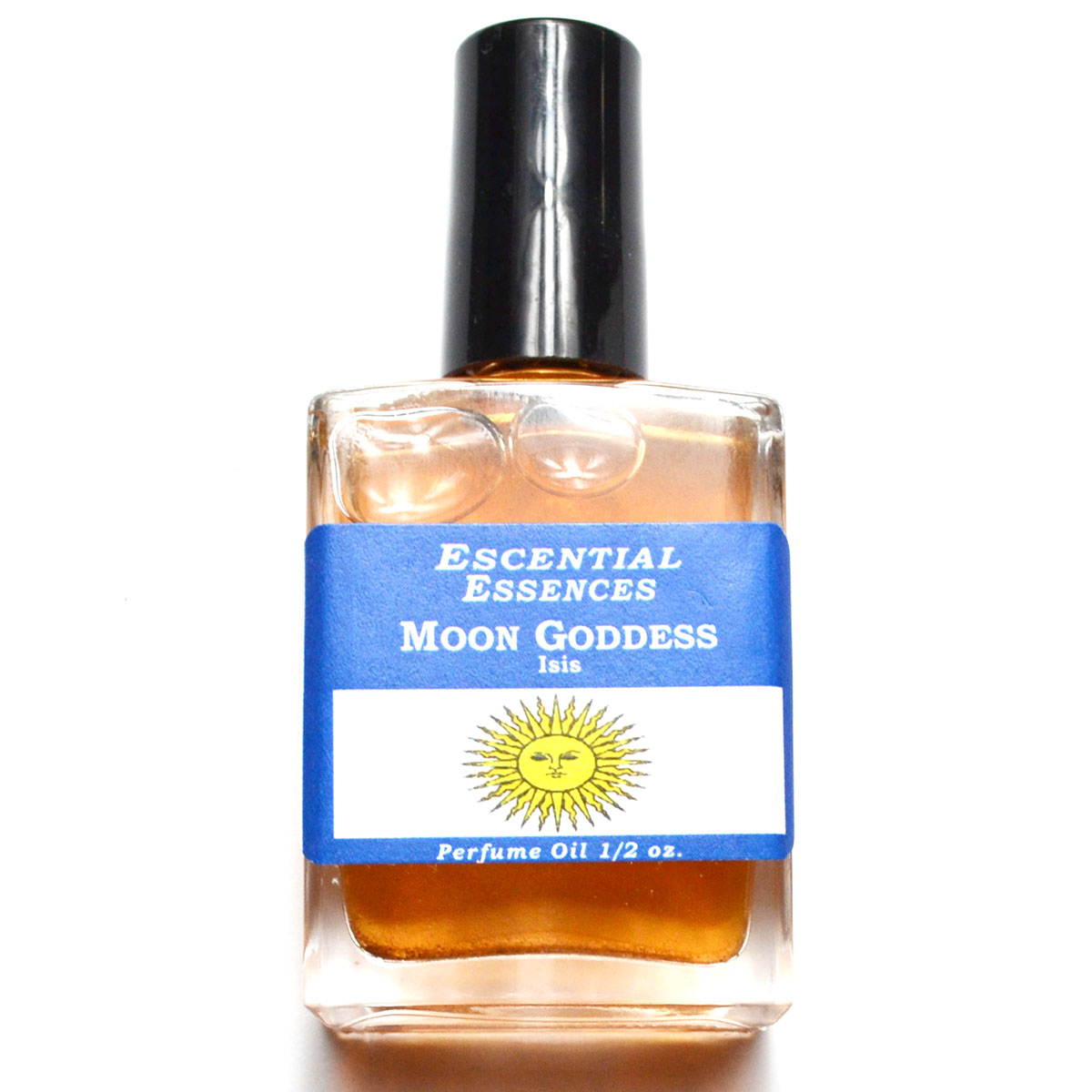

Moon Goddess essences oil
$12.04
An Isis oil for lunar rites
A Moon Goddess perfume oil dedicated to Isis, for peace, blessing and consecration in lunar rites and full moon work.
Quick Uses
- Full moon: anoint a white or silver candle at the full moon and set it where the moonlight falls.
- Charms: dress a moonstone or silver charm to keep the Moon’s blessing with you.
- Isis: anoint the candles and statue of a rite to Isis, offering water, milk or flowers.
- Lunar tools: consecrate the cup and other lunar tools on a Monday.
How to Use It
Witchcraft & Folk Magick
- Anoint a white or silver candle at the full moon and set it where the moonlight falls.
- Dress a moonstone or a silver charm to keep the Moon’s blessing with you.
Ceremonial & Occult Magick
- Anoint the candles and statue of a rite to Isis, offering water, milk or flowers.
- Consecrate the cup and other lunar tools on a Monday.
- Anoint the brow before astral work on the night of the full moon.
A Simple Working
- On the night of the full moon, set a white or silver candle by a window.
- Fill a cup with clean water and place it beside the candle.
- Anoint the candle and your brow with the oil.
- Light the candle and greet the Moon and Isis by name.
- Ask for peace in your home and blessing on your work.
- Drink a little of the water or pour it on a plant in the morning.
- Let the candle burn out.
Pairs Well With
- Moonstone, the classic lunar stone.
- Silver or white candles, for Moon devotion.
- Jasmine, a night-blooming flower of the Moon.
- A silver or glass cup, for moon-charged water.
- Myrrh, an Egyptian temple resin to burn alongside.
What You Receive
Moon Goddess perfume oil, in a 1/2 oz bottle, blended in cosmetic-grade oils.
Origin & Lore
Isis was one of the great goddesses of Egypt, wife of Osiris and mother of Horus, renowned for her magick. In the Greco-Roman world her worship spread across the Mediterranean and she became closely linked with the Moon and the sea. This oil is made for lunar devotion, blessing, peace and astral work under her name.
In the Roman novel The Golden Ass, the hero wakes on a beach under the full moon and prays, and Isis rises from the sea crowned with a gleaming disc to answer him.
The cult of Isis spread from Egypt to Rome and beyond, with temples as far away as London. In The Golden Ass, Apuleius has the goddess describe herself as the queen of heaven and mother of nature, worshipped under many names, and she was honoured with a spring festival of ships when sailing season reopened.
Did You Know?
The temple of Isis at Philae was one of the last places where ancient Egyptian religion was practised, and was closed by order of the emperor Justinian in the sixth century.
| Weight | 0.16 lbs |
|---|
Related products