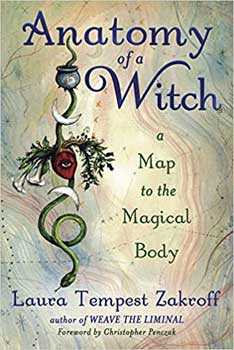

Anatomy of a Witch Oracle by Laura Tempest Zakroff
$27.49
Read the Witch’s Body
A 48-card oracle built on the witch’s body as the first and most personal tool of the craft, for readers who want to know where their power is leaking and where to put it.
Quick Uses
- Daily check: Pull one card each morning to see which part of your life or body needs your attention.
- Before ritual: Draw a card to learn which sense or bodily system to lead with in the working.
- Glamour: Lay a card on your mirror while you dress and anoint for a glamour working.
- Moon tracking: Draw at each new and full moon and compare the two readings.
How to Use It
Witchcraft & Folk Magick
- Use the lunar and solar cards to time workings to the body’s own rhythms.
- Pull a card before anointing to choose where on the body the oil goes.
- Read for a client and suggest a small body-based charm drawn from the card.
Ceremonial & Occult Magick
- Treat the deck as a map of the magickal body and draw before energy work or meditation.
- Use a drawn card as the subject of a pathworking.
Demonology & Black Magick
- Read before evocation to see where you are depleted, so you do not open a circle running on empty.
- Draw afterward to read where a spirit contact has landed in the body and what needs grounding.
- Use a card as the focal image for a working of personal power before a pact or offering rite.
A Simple Working
- Set a red chime candle on your altar with a dish of salt and a small mirror.
- Anoint your wrists with a drop of rosemary oil and light the candle.
- Shuffle while breathing slowly and ask which part of you is calling for attention.
- Draw one card and read it with the companion book.
- Touch the place on your body the card points to and speak aloud what you will do for it this week.
- Lay the card face up beneath the mirror until the candle burns out.
- Record the card and your promise in your journal.
Pairs Well With
- Rosemary oil, for anointing the body before and after readings.
- A hand mirror, for glamour and self-reading.
- Red chime candles, for vitality and quick body-centred workings.
- A tarot bag, to keep the deck charged and protected between readings.
What You Receive
A 48-card oracle deck with a full-colour companion book.
Origin & Lore
Oracle decks are freer than tarot: they carry no fixed number of cards or suits, so each one is built around a single theme. The tradition runs back to eighteenth-century fortune-telling cards made purely for divination rather than for play.
Laura Tempest Zakroff’s deck draws on the systems of the magickal body, lunar and solar events and the senses, treating the body as the meeting point of the material and the metaphysical.
Did You Know?
Jean-Baptiste Alliette, known as Etteilla, issued what is generally counted as the first tarot deck designed specifically for divination around 1789.
| Weight | 1.3 lbs |
|---|
Related products