

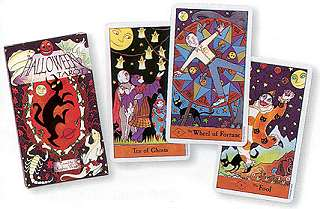
Halloween Tarot by West & Kipling
$24.14
Old-Time Halloween Tarot
A full 78-card tarot drawn in Kipling West’s festive old-time Halloween style, loved by readers who keep Samhain spirit on the table all year.
Quick Uses
- Samhain Spread: Read the year ahead on Halloween night, one card for each month.
- Party Readings: Use its playful art to read for friends at an October gathering.
- Ancestor Night: Draw a card at the ancestor altar and read it as a message from the dead.
- Learning Deck: Its traditional structure makes it easy to study alongside any tarot book.
How to Use It
Witchcraft & Folk Magick
- Lay out a twelve-card year-ahead spread on Samhain night and keep it photographed for reference.
- Draw a card for each guest at a dumb supper and read it after the meal.
Ceremonial & Occult Magick
- Assign each suit to its element and read for the balance of forces at the turn of the year.
- Pick the Death or Moon card as a focus for a meditation on endings and the underworld.
Demonology & Black Magick
- Read before and after calling on the dead, asking who answered and whether they are settled.
- Ask a spirit to choose a card in reply to your question and log it with your offerings.
- Lay the Devil or Ten of Swords as the image at the centre of a hex worked on Samhain.
A Simple Working
- On Samhain night, carve or set out a lantern with a white candle inside.
- Burn a pinch of mugwort and lay out a dish of apples for the dead.
- Shuffle while asking what the coming year holds.
- Lay twelve cards in a circle, one for each month starting from November.
- Read each card in turn and write down a one-line note for each month.
- Leave the apples outside overnight as an offering.
Pairs Well With
- Mugwort: a classic Samhain herb for divination smoke.
- White tealights: to set in a lantern for the dead.
- Ancestor altar cloth: a dedicated cloth for October readings.
- Journal: to keep the twelve-month spread and check it through the year.
What You Receive
One tarot deck of 78 cards with an instructional booklet.
Origin & Lore
Tarot was invented as a card game in fifteenth-century Italy and became a fortune-telling tool from the late 1700s. Halloween, meanwhile, grew from the Gaelic festival of Samhain, when apples, nuts and mirrors were used in folk divinations about marriage and death.
Kipling West’s deck brings these two together in a cheerful, vintage Halloween look while keeping the full 78-card structure.
Did You Know?
The first jack-o’-lanterns in Ireland and Scotland were carved from turnips and swedes; pumpkins took over after the custom crossed to North America.
| Weight | 0.5 lbs |
|---|
Related products

Crystal Balls