


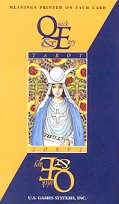
Quick and Easy Tarot by Lytle & Ellen
$24.14
Tarot with Meanings on Every Card
A 78-card tarot with upright and reversed meanings printed on each card, used by readers who want to read at once without stopping for the book.
Quick Uses
- First readings: Read straight from the cards with no need for a book.
- Learning: Use the printed meanings to learn the deck as you read.
- Reversals: Turn each card upside down to read the reversed meaning at the other end.
- Quick checks: Draw one card for a fast answer between longer readings.
How to Use It
Witchcraft & Folk Magick
- Read before a spell to see what it needs.
- Use the deck at sabbats for quick readings for the circle.
Ceremonial & Occult Magick
- Study the Major Arcana with its printed meanings as a base before adding occult correspondences.
- Keep the deck as a fast checking tool during long rituals.
Demonology & Black Magick
- Ask a spirit to answer through the cards inside the circle, reading the printed meaning as its words.
- Read before an evocation for timing and afterwards for the outcome.
A Simple Working
- Light a yellow candle and burn a little frankincense.
- Shuffle and cut the deck into three piles.
- Draw one card from each pile: situation, challenge, advice.
- Read the printed meanings, noting which fall reversed.
- Write the reading in your journal.
- Return the cards and thank the powers you called.
Pairs Well With
- Tarot journal – for learning through your readings.
- Velvet tarot bag – keeps the deck clean.
- Frankincense – a general offering for readings.
- Tarot cloth – a set surface for spreads.
What You Receive
One tarot deck of 78 cards with upright and reversed meanings printed on each card, plus an instructional booklet.
Origin & Lore
Tarot began as a card game in fifteenth-century Italy and became a divination tool in eighteenth-century France. Printing short meanings on the cards themselves is an old idea from the early days of cartomancy.
This deck keeps the standard 78 cards and puts both meanings on the face, for readers who want to learn by doing.
Did You Know?
Around 1789 the Paris occultist Etteilla published the first tarot deck made for divination, and his cards had their upright and reversed keywords printed on them, much like this deck.
| Weight | 0.6 lbs |
|---|
Related products


Altar Supplies


Crystal Balls