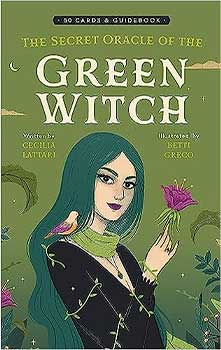
Secret Oracle of the Green Witch by Lattari & Greco
$26.35
Herbal Lore of the Hedge Witch
A 50-card oracle with a 65-page illustrated guidebook that gathers the herbs, tools, creatures and tales of green, hedge and kitchen witchcraft, used both for reading and for planning spellwork.
Quick Uses
- Spell planning: Draw a card to choose which herb, charm or tool your next working needs.
- Garden reading: Read a card in the garden or woods and note what the plants say.
- Study: Work through the deck to learn the plants and creatures used in charms and potions.
- Kitchen witchery: Pull a card before cooking a meal with intent.
How to Use It
Witchcraft & Folk Magick
- Draw a card before gathering or buying herbs to see which plant belongs in the spell.
- Lay the card for a herb beside the jar while you make a charm bag, oil or potion.
Hoodoo & Rootwork
- Use the deck to choose roots and herbs for a mojo bag or a bath.
- Lay a drawn card under the dish of a candle working as its focus.
Demonology & Black Magick
- Draw to divine which plant offering a spirit prefers before an evocation.
- Use plant cards to plan the herbs of a baneful or binding working, then read again after the rite.
A Simple Working
- Set out a small cloth bag, a bowl and three dried herbs you keep to hand.
- Light a green candle.
- Ask the deck what your charm needs and draw three cards.
- Match each card to a herb, tool or creature in the guidebook.
- Add the herbs the cards point to into the bag, naming each one’s purpose.
- Tie the bag and pass it through the candle smoke.
- Carry it until the next new moon.
Pairs Well With
- A green chime candle: for growth and herbal workings.
- Mugwort and rosemary: two everyday hedge witch herbs for a reading table.
- Small cloth charm bags: for building what the cards suggest.
- A blank grimoire: to record herbs and spells as you learn them.
What You Receive
One oracle deck of 50 cards with a 65-page illustrated guidebook.
Origin & Lore
Oracle decks descend from the fortune-telling cards that spread through Europe from the late eighteenth century: packs with their own fixed images and meanings, free of the 78-card tarot structure, made to be read directly for omens and counsel.
This deck takes the reader into the garden and the woods of the green, hedge and kitchen witch. Its cards show the herbs, tools, plants, animals and natural elements used for charms, talismans and potions, and the stories and symbols that go with them.
Did You Know?
Jean-Baptiste Alliette, known as Etteilla, published around 1789 what is usually counted as the first card deck designed specifically for divination.
| Weight | 0.8 lbs |
|---|
Related products