

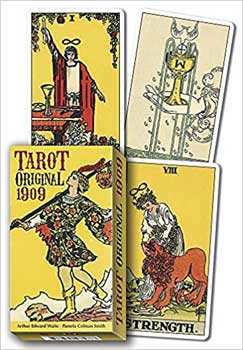
Tarot Original 1909 by Waite & Smith
$27.45
The 1909 Waite-Smith Tarot
A reproduction of the very first December 1909 edition of the Waite-Smith deck, the reference tarot for clear, traditional readings.
Quick Uses
- Learn tarot: Use this as your study deck, since most books and guides are written for its images.
- Daily draw: Pull one card each morning and compare its picture to your day.
- Reference deck: Check unfamiliar modern decks against this one to see the original symbol.
- Serious readings: Keep it for important questions where you want the plain, classic voice.
How to Use It
Witchcraft & Folk Magick
- Read with this deck at the start of any spell to see how the work is likely to go.
- Use individual cards as images in candle spells, laying the card under or beside the candle.
Ceremonial & Occult Magick
- Work through the Golden Dawn attributions that Waite and Smith built into the images: the zodiac, planets and Hebrew letters of the Majors.
- Use the Magician as the image of the ritualist and his tools when opening a working.
Demonology & Black Magick
- Read before and after an evocation to judge the timing and the result.
- Ask a spirit to answer through the cards once it has been called and given its offering.
- Use the Devil card as the focal image of a pact working or a binding.
A Simple Working
- Light a white candle and a stick of frankincense.
- Pass the deck through the smoke, then shuffle.
- Pull the Magician and set it face up as your significator.
- Draw three cards beside it: what you hold, what you lack, what to do next.
- Read the pictures before checking any meanings.
- Write down the reading with the date.
- Return the Magician to the deck last.
Pairs Well With
- Frankincense resin, for cleansing the deck before serious work.
- A tarot cloth, for a clean reading surface.
- A blank journal, for keeping a record of readings.
- A Marseille deck, to compare with the older pattern.
What You Receive
78 full-colour tarot cards and instructions by Sasha Graham, reproduced from the first edition of December 1909.
Origin & Lore
Tarot became a divination tool in France in the late 1700s, and by the 1880s the Hermetic Order of the Golden Dawn had built it into a full system of correspondences. Arthur Edward Waite designed this deck from that system and Pamela Colman Smith painted it.
Its great innovation was illustrating every card, including the numbered minors, with a full scene, which made it far easier to read intuitively.
Did You Know?
The only earlier deck with fully illustrated pip cards that Smith is known to have drawn on is the 15th-century Italian Sola Busca tarot, photographs of which were shown at the British Museum in 1907.
| Weight | 0.6 lbs |
|---|
Related products