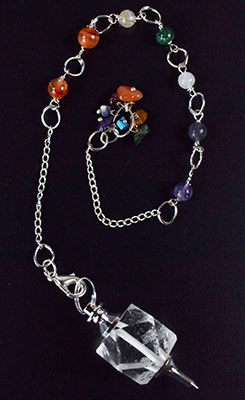
Clear Quartz Hexagon Chakra Pendulum
$12.04
Hexagonal Quartz On A Detachable Chain
A six-sided clear quartz pendulum on a chakra-bead chain that unclips, for practitioners who want one tool for both dowsing and energy work.
Quick Uses
- Dowsing: Hold the chain between thumb and forefinger and let the hexagon settle before asking.
- Energy Work: Pass it slowly over each chakra and note where the swing changes.
- Detach: Unclip the chain to rest the stone on a grid or in your palm during meditation.
- Map Work: Swing it over a map to choose a place to look for a lost item.
How to Use It
Witchcraft & Folk Magick
- Dowse over a list of herbs or stones when building a spell bag.
- Hang it in sunlight for a day to cleanse it after heavy use.
Hoodoo & Rootwork
- Ask it which day of the week to begin a nine-day candle working.
- Dowse over your curio box to pick the root or herb a working needs.
Demonology & Black Magick
- Rest the detached stone on a seal between sessions and swing the full pendulum over it during them.
- Ask before an evocation whether the spirit is willing to come, and afterwards whether the working is closed.
- Keep the answers in your evocation log.
A Simple Working
- Work in daylight with a white chime candle and a bowl of water with a pinch of salt.
- Dip the pendulum stone briefly in the salted water and dry it.
- Light the candle and hold the pendulum over it at a safe height.
- Ask it to show yes and no, and note them.
- Pass it down from crown to root, noting any change in the swing.
- Pour the water away outside and keep the pendulum in a cloth.
Pairs Well With
- White chime candles – a plain light for cleansing and dedication.
- Sea salt – for a quick salt-water rinse of the stone.
- A crystal grid cloth – a base for the detached stone.
- A journal – to note chakra readings over time.
What You Receive
One clear quartz hexagon pendulum, about 12″ long, on a chain set with chakra-coloured beads. A clasp lets you detach the chain from the pendulum. As a natural stone, each piece varies slightly in colour and pattern.
Origin & Lore
A pendulum is the simplest of the dowsing tools: a weighted bob that, held still over a question, a map or a written chart, answers by the direction of its swing. Dowsers, cunning folk and later the French radiesthesists all relied on it.
Quartz was the classic material for crystal balls and amulets, and in folk belief it was thought to hold whatever was put into it. A clear quartz pendulum keeps that tradition, giving you a tool that can be cleansed back to blank between uses.
Did You Know?
In 1833 the French chemist Michel-Eugène Chevreul published his experiments with hand-held pendulums, concluding their swing came from tiny unconscious movements of the hand, an idea later called the ideomotor effect.
| Weight | 0.07 lbs |
|---|
Related products