

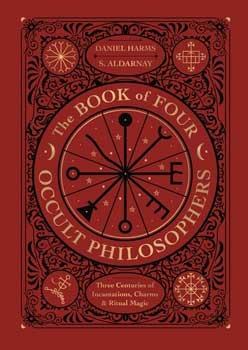
Book of Four Occult Philosophers by Daniel Harms & S. Aldarnay (Hardcover)
$82.50
A Grimoire Of Four Hands
An annotated hardcover transcription of a handwritten manuscript of charms, seals, talismans and spirit operations, kept in its original red and black text.
Quick Uses
- Seal Study: Copy one of its illustrated seals by hand to learn its construction.
- Historical Notes: Read the annotations alongside each operation to see where it came from.
- Spirit Work: Study its spirit-binding operations before writing your own.
How to Use It
Ceremonial & Occult Magick
- Work through its astrology and numerology material to time talismans as the old operators did.
- Use it as a comparison text beside other grimoires you own.
Witchcraft & Folk Magick
- Read its fairy lore and charms as a window into English and Welsh cunning practice.
- Use its mandrake material to study the root’s place in old magickal herbals.
Demonology & Black Magick
- Study its demon-conjuring passages to see how working magicians recorded these rites by hand.
- Copy a seal from its pages onto parchment as a focus for your own spirit work.
A Simple Working
- On a Saturday night, clear your altar.
- Light a black candle and burn a little frankincense.
- Choose one seal illustrated in the book.
- Copy it carefully onto parchment with black ink.
- Hold the finished seal in the smoke and state your purpose.
- Wrap it in black cloth and keep it with your working tools.
Pairs Well With
- Parchment Paper: For copying seals and talismans.
- Dragon’s Blood Ink: For drawing seals by hand.
- Frankincense Resin: For consecrating finished seals.
- Black Candles: For Saturn-hour work.
What You Receive
One copy of Book of Four Occult Philosophers, transcribed and annotated by Daniel Harms with illustrations by S. Aldarnay. Hardcover, 7.25″ x 10.25″.
Origin & Lore
The book presents a manuscript built up over three centuries by four hands: Robert Cross Smith, known as Raphael, Olivia Serres, known as Princess Olive, Thomas Harrington, and an unknown writer signed W. Its contents run from spells and spirit binding to fairies, astrology, numerology and demon conjuring, with transcriptions and translations from English, Latin and Welsh.
Robert Cross Smith was an English astrologer of the early 1800s who wrote under the name Raphael. Olivia Serres was a painter who claimed to be a princess of the British royal house. Manuscripts like this one show how working magicians copied and passed on older material.
Did You Know?
Old herbals repeat the legend that a mandrake shrieks when pulled from the ground, and that a dog should be tied to the root to pull it up instead.
Related products