



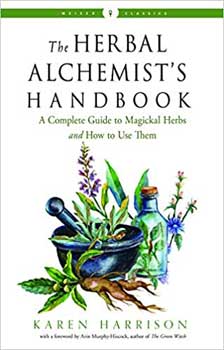


Herbal Alchemist’s Handbook by Karen Harrison
$20.85
Herbs Matched To The Planets
A working compendium of over 150 herbs with their astrological ties and recipes for incense, oils, bath salts, amulets and fluid condensers.
Quick Uses
- Planetary Pick: Choose herbs for a spell by the planet that rules your goal.
- Oil Blending: Make one ceremonial oil from the book and use it to dress candles for a month.
- Bath Salts: Mix a ritual bath salt and soak before your next working.
How to Use It
Witchcraft & Folk Magick
- Blend a prosperity incense and burn it every Thursday through a lunar month.
- Sew an herbal amulet for courage and carry it in your left pocket.
Ceremonial & Occult Magick
- Mix your oils and incense in the planetary hour of the ruling planet for a stronger link.
- Make a fluid condenser and use it to charge talismans before consecration.
Demonology & Black Magick
- Blend a Saturnian incense for spirit work and burn it only for that purpose.
- Use a fluid condenser to anoint a spirit’s seal before you call it.
A Simple Working
- Pick a goal and find the planet that rules it in the book.
- On that planet’s day and hour, set out the herbs listed for it.
- Grind them together in a mortar while stating your aim.
- Add a few drops of olive oil to bind the blend.
- Burn a pinch on charcoal and breathe in the smoke.
- Store the rest in a labelled jar for future workings.
Pairs Well With
- Mortar & Pestle: For grinding herbs and resins.
- Charcoal Tablets: For burning your loose incense.
- Olive Oil: A plain carrier for ceremonial oils.
- Amber Glass Bottles: To store oils and condensers.
What You Receive
One copy of Herbal Alchemist’s Handbook by Karen Harrison. Paperback, 5.8″ x 9″, 272 pages.
Origin & Lore
The book gathers more than 150 herbs with their energy and astrological ties, and teaches you to blend incense, ceremonial oils, bath salts, amulets, philtres and fluid condensers for courage, prosperity, psychic power and more.
Linking herbs to planets is an old practice. Renaissance magi such as Marsilio Ficino and Cornelius Agrippa listed plants under the planets, and the English herbalist Nicholas Culpeper gave each herb a ruling planet in his herbal of the 1650s. The fluid condenser is a later idea, made popular by the Czech occultist Franz Bardon in the twentieth century.
Did You Know?
Nicholas Culpeper’s herbal, first printed in 1652, has never gone out of print.
Related products


