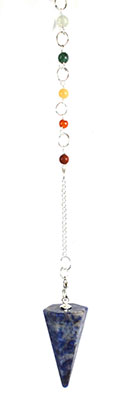
6-Sided Sodalite Chakra Pendulum
$8.75
Deep Blue Stone For Clear Thought
A faceted sodalite pendulum on a chakra-bead chain, reached for when a question needs a cool head rather than wishful thinking.
Quick Uses
- Study: Dowse over your reading list or course notes to choose what to work on next.
- Clear Questions: Write your question down first, then hold the pendulum over the paper so the wording stays exact.
- Throat and Brow: Pass it over the throat and brow centres before a reading to check you are ready to speak plainly.
- Daily Draw: Ask one short question each morning and keep a log of the answers and outcomes.
How to Use It
Witchcraft & Folk Magick
- Use it to pick between two spell timings or two herbs when your books disagree.
- Keep it on your altar beside a blue candle during study or exam spells.
Ceremonial & Occult Magick
- Dowse over a table of correspondences to find the planetary or elemental fit for a working you are designing.
- Use it alongside your magickal diary to check the meaning of a vision or dream you have recorded.
Demonology & Black Magick
- Dowse over a page of seals to learn which spirit is willing to teach on a subject before you attempt contact.
- After an evocation, ask yes or no questions to confirm what you understood of the spirit’s answers.
- Keep a dated record of every question and swing in your grimoire.
A Simple Working
- Work on a Wednesday with a blue chime candle and a little rosemary.
- Burn the rosemary and pass the pendulum through the smoke.
- Write a single study question on a slip of paper.
- Ask the pendulum for its yes and no swings, then hold it over the paper.
- Record the answer, then pinch out the candle and keep the slip in your study book.
- Check the answer against what happens and note it.
Pairs Well With
- Blue chime candles – a plain light for study and clarity work.
- Rosemary – the traditional herb of memory, for smoke or a sachet near your books.
- A blank journal – for keeping a running log of questions and answers.
- A pendulum chart – gives the swing a wider range of answers.
What You Receive
One 6-sided sodalite pendulum on a chain decorated with beads representing the seven chakras. A fob-style latch lets you remove the pendulum from the chain. As a natural stone, each piece varies slightly in colour and pattern.
Origin & Lore
Long before crystal pendulums, country people hung a wedding ring or a needle on a thread and read its swing for yes and no, a practice found across Europe and carried into folk divination everywhere.
Sodalite is a royal-blue mineral often veined with white calcite. In modern practice it is used as a stone of reason and honest speech, which makes it a natural partner for divination where you need to hear the answer rather than the one you wanted.
Did You Know?
Sodalite was formally described in 1811 from specimens found in Greenland, and its name refers to the sodium it contains.
| Weight | 0.03 lbs |
|---|
Related products