

Abra Melin oil
$80.25
The grimoire’s holy anointing oil
An Abra Melin oil named for the grimoire’s holy anointing oil, worked in hoodoo for influence and in ceremonial magick to consecrate the practitioner and tools.
Quick Uses
- Influence: dress a purple candle to bend a person or situation to your wishes.
- Ritual: anoint the brow and the top of the head at the start of a ritual, following the grimoire’s instructions.
- Consecration: consecrate the altar, lamen, wand and other tools.
- Evocation: anoint yourself before evocation and dress the seals and talismans of spirits to be constrained.
How to Use It
Hoodoo & Rootwork
- Dress a purple candle to bend a person or situation to your will.
- Anoint your hands and throat before a meeting where you need to command respect.
Ceremonial & Occult Magick
- Anoint the brow and the top of the head at the start of a ritual, following the grimoire’s instructions.
- Consecrate the altar, lamen, wand and other tools.
- Dress the candles of a working of the holy guardian angel.
Demonology & Black Magick
- Anoint the magician before evocation, since the Abramelin system includes commanding spirits once the angel has been attained.
- Dress seals and talismans of spirits to be constrained.
A Simple Working
- Cleanse yourself with a bath or salt water before beginning.
- Dress a white or gold candle with Abra Melin oil from base to wick.
- Anoint your brow, crown and palms.
- Light the candle and pray or speak your aspiration toward your highest self or guardian angel.
- Anoint each tool on the altar, naming its purpose.
- Sit in silence until the candle has burned down.
Pairs Well With
- Frankincense, the classic incense of consecration.
- Myrrh, an ingredient of the original holy oil.
- A white or gold candle, for solar and divine work.
- Cinnamon, another ingredient of the grimoire’s oil.
- A lamen or talisman, to consecrate with the oil.
What You Receive
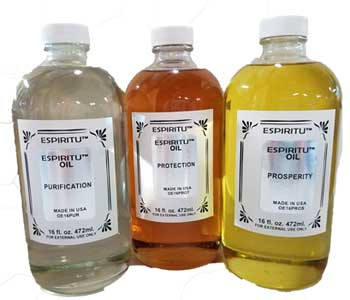
Abra Melin oil, in a 16 oz bottle.
Origin & Lore
Abramelin oil takes its name from The Book of Abramelin, a grimoire attributed to Abraham of Worms, which gives a recipe for a holy anointing oil based closely on the one in Exodus. In ceremonial magick it is used to consecrate the magician, the altar and tools; in hoodoo and spiritual-supply traditions it also came to be sold as a commanding oil, used to bend others to the worker’s will.
Few oils have a longer occult pedigree: the recipe comes from a grimoire that promised its reader conversation with their holy guardian angel and command over spirits.
The Book of Abramelin presents itself as a fifteenth-century manuscript in which Abraham of Worms passes on the system he learned from the Egyptian mage Abramelin. Its oil is described as a mix of myrrh, cinnamon and galangal in olive oil, and after its English translation was published in 1898 it became a central text for the Golden Dawn and later Thelema.
Did You Know?
The first English translation of the Book of Abramelin was made from a French manuscript held in the Bibliothèque de l’Arsenal in Paris.
| Weight | 2 lbs |
|---|
Related products