


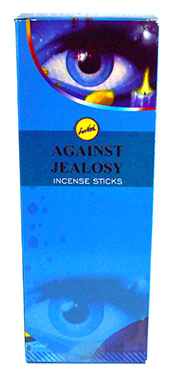
Against Jealousy incense sticks
$9.85
A shield against envy and the eye
Stick incense for turning away envy, jealousy and the evil eye, burned to cleanse a person or home after envious looks.
Quick Uses
- Envy cleansing: pass a lit stick around your body from head to feet after a gathering where you felt resented.
- Amulets: smoke a blue eye bead, red string or hand-shaped charm and wear it the next day.
- Business envy: burn it at the shop door to keep jealous competitors from souring trade.
- Egg limpia: burn it during an egg cleansing, then break the egg into a glass of water afterwards.
How to Use It
Witchcraft & Folk Magick
- Clearing a stare: after a gathering where you felt watched or resented, light a stick and pass it around your body from head to feet.
- Charging an amulet: smoke a blue eye bead, a red string or a hand-shaped charm and wear it the next day.
- Business envy: burn it at the shop door to keep jealous competitors and customers from souring trade.
Folk Catholicism & Spiritism
- Egg limpia: in Mexican and Latin American practice, a raw egg is rubbed over the body while praying; burn the incense during the cleansing and break the egg into a glass of water afterwards.
- Protecting the young: babies are thought especially vulnerable to the eye, so the smoke is passed around the cradle and a red string tied on.
A Simple Working
- Light a white chime candle and one stick of Against Jealousy incense.
- Hold a raw egg and pass it slowly over your body from the crown downward.
- Say the Our Father, or your own words asking that all envy be removed.
- Crack the egg into a glass of water and set it beside the candle.
- Pass your hands through the smoke and then over your face.
- Flush the egg away and rinse the glass with salt water.
Pairs Well With
- Evil eye bead: the classic blue amulet against the eye.
- White chime candle: for cleansing work.
- Red string: tied at the wrist for protection.
- Rue: the traditional herb of Mediterranean anti-envy charms.
What You Receive
Against Jealousy stick incense, a box of 6 hexagon packs with 20 sticks in each (120 sticks).
Origin & Lore
Against Jealousy (Contra Envidia) is a modern formula incense for an ancient worry: that envy, spoken or unspoken, brings bad luck, illness and trouble. Across the Mediterranean, the Middle East and Latin America, people protect themselves with amulets, cleansings and prayer against mal de ojo, and smoke is one of the oldest ways to clear it.
The Latin for envy, invidia, comes from in-videre, to look upon. Long before anyone said “evil eye”, people knew that a jealous stare could do damage.
Plutarch devoted one of his Table Talk dialogues to whether some people can harm others simply by looking at them, and his speakers take it seriously. Romans protected children and doorways from the envious eye with the fascinum, a small phallic amulet, and Pliny the Elder records charms and gestures against fascination.
Did You Know?
The English word “fascinate” comes from Latin fascinare, which first meant to bewitch, especially with the evil eye.
| Weight | 0.8 lbs |
|---|
Related products


