



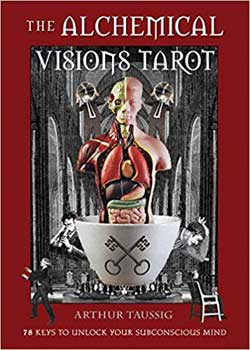
Alchemical Visions Tarot by Arthur Taussig
$54.95
Tarot Through the Alchemical Furnace
An oversized 78-card tarot with a 192-page book that reads the arcana as stages of the Great Work, used by readers who want shadow work with real teeth.
Quick Uses
- Shadow reading: Draw three cards at the dark moon for what must be burned away, what is being distilled, and what remains as gold.
- Before a working: Pull one card to read the state of the operation before you light a single candle.
- Study: Work through one Major Arcana card a week with the book, noting which alchemical stage it shows you.
- Altar focus: Stand a single card behind your working candle as the image the rite is built around.
How to Use It
Witchcraft & Folk Magick
- Read at each moon phase to track a long working from first sowing to harvest.
- Lay a card under a jar or poppet as the picture of the outcome you are working toward.
Ceremonial & Occult Magick
- Use the Majors as meditation keys for nigredo, albedo and rubedo, the black, white and red stages of the Great Work.
- Pair cards with planetary hours so the image and the timing of a ritual speak the same language.
- Keep the deck on the altar during Hermetic or Qabalistic study and draw a card before each session.
Demonology & Black Magick
- Read before an evocation to see whether the time and the operator are ready, then again afterward to read what was set in motion.
- Ask a spirit already called into the circle to answer through a single drawn card.
- Use the darker Majors such as The Devil, Death and The Tower as the focal image of a hex, a binding or a pact working.
A Simple Working
- Cleanse the deck in frankincense smoke and set a black chime candle and a white chime candle side by side.
- Light the black candle and name what in you or your situation needs to be broken down.
- Shuffle and draw one card for the nigredo: what must rot and fall away.
- Light the white candle and draw a second card for the albedo: what is being washed clean.
- Draw a third card for the rubedo: what can be made solid and lasting.
- Write the three cards and your reading in your journal and let both candles burn down.
- Keep the third card on your altar until the next dark moon.
Pairs Well With
- A black altar cloth, to give the oversized cards a clean field to be read on.
- Frankincense resin, for clearing the deck and the room before and after reading.
- A blank journal or grimoire, to record spreads and follow how they unfold.
- Black and white chime candles, for workings built on the alchemical stages.
What You Receive
A boxed tarot set: 78 oversized cards and a 192-page book in a 5″ x 7″ silver box with a picture window.
Origin & Lore
Tarot began as a card game in fifteenth-century Italy and only became a tool for divination and occult study in the eighteenth century. From the Golden Dawn onward, occultists tied its trumps to Hermetic and alchemical symbolism, and that is the current this deck works in.
Arthur Taussig builds the deck around the Hero’s Journey running through both Major and Minor Arcana, drawing out the psychological side of the archetypes while staying in the line of the Waite and Marseille decks.
Did You Know?
The oldest surviving tarot cards are the hand-painted Visconti-Sforza decks made for the ruling families of Milan in the mid-1400s.
| Weight | 2.7 lbs |
|---|
Related products


Altar Supplies

