



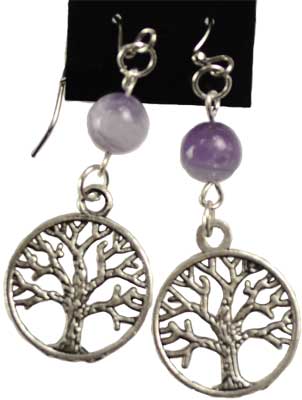
Amethyst Tree of Life Earrings
$8.75
Purple Sight, Deep Roots
Amethyst beads with pewter Tree of Life charms, worn for clear sight, sober judgement and the old image of the world tree linking every realm.
Quick Uses
- Clear Head: Wear them to rituals and readings where you need a sober, steady mind.
- Dreamwork: Leave them on the nightstand when you want clear, remembered dreams.
- Thursday Charge: Rest them on your altar during a Jupiter hour to renew them.
How to Use It
Witchcraft & Folk Magick
- Wear them while reading or journeying, and visualise the Tree’s roots carrying you down and its branches carrying you up.
- Pass them through mugwort smoke before sleep and set them beside your pillow for dreamwork.
Ceremonial & Occult Magick
- Consecrate them on a Thursday in a Jupiter hour with a blue candle as a small Jovian talisman.
- Wear them during pathworking on the Kabbalistic Tree of Life as a reminder of the route between spheres.
Demonology & Black Magick
- Wear them during evocation to keep your head clear and your judgement your own.
- Lay one earring on a spirit’s seal and keep the other on you to hold a line of communication between sessions.
A Simple Working
- On a Thursday night, light a purple chime candle.
- Burn a pinch of mugwort beside it.
- Hold the earrings and picture a great tree with roots below and branches above.
- Ask to be shown one thing you need to know.
- Set them by your bed and sleep.
- Write down whatever you remember on waking.
Pairs Well With
- Mugwort: Dream and vision herb to burn with them.
- Purple Chime Candles: Small candles for charging.
- Dream Journal: To record what the night brings.
- Selenite Wand: A clean resting place for the earrings between uses.
What You Receive
A pair of earrings on hypoallergenic surgical steel French hooks, each with a 1/4″ amethyst bead and a 1/2″ pewter Tree of Life charm. Overall length 2 1/8″. Materials: Amethyst, pewter and surgical steel. Made in USA. Natural stone beads vary slightly in colour and pattern.
Origin & Lore
Amethyst is purple quartz, and its Greek name amethystos means not drunk; it was worn and carved into cups as a charm against drunkenness. It became the traditional stone of bishops’ rings, hence the folk name Bishop’s stone.
The world tree appears in many traditions. In Norse lore it is Yggdrasil, the great ash joining the nine worlds, on which Odin hung for nine nights to win the runes.
Did You Know?
The story of a nymph named Amethyste turned to stone and stained purple by Bacchus’ wine is not ancient; it comes from a poem by the French Renaissance poet Remy Belleau, published in 1576.
Related products


