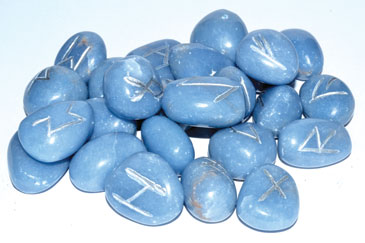
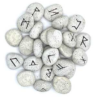
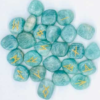
Angelite Rune Set
$29.65
Soft Blue Runes For Gentle Questions
A rune set carved in pale blue angelite, chosen by casters who want a calm, quiet stone for asking spirit guides and ancestors for counsel.
Quick Uses
- Guidance: Draw one rune and ask your guides what it means for you today.
- Household Questions: Cast three runes over a matter of home and family and read them together.
- Ancestor Sitting: Draw a rune at your ancestor altar after leaving an offering.
- Meditation: Hold a single rune and sit with its shape and sound.
How to Use It
Witchcraft & Folk Magick
- Lay a rune of peace such as Wunjo beneath a candle for a calmer household.
- Draw a rune at the ancestor altar to receive a message from the dead.
Ceremonial & Occult Magick
- Use runes as meditation keys, chanting each stave’s name while holding the stone.
- Ask your holy guardian or a guiding spirit to choose the rune from the bag.
Demonology & Black Magick
- Cast before and after an evocation to read the ground the working stands on and what it has stirred.
- Ask a called spirit to guide your hand into the bag, then read the runes it draws as its answer.
- Lay a single rune such as Thurisaz or Hagalaz on a seal or petition as the focal image of a hex or binding.
A Simple Working
- Light a blue or white candle and set a glass of water beside it.
- Speak to your guides or ancestors and ask for their counsel.
- Hold the pouch and let your hand choose one rune.
- Lay it before the candle and sit with its shape for a few minutes.
- Write down what comes to mind, then read its traditional meaning.
- Thank your guides and return the rune to its pouch.
Pairs Well With
- A rune cloth: soft ground for casting stone runes.
- Blue chime candles: for calm and peaceable workings.
- Lavender: burned or set nearby for a quiet sitting.
- A pendulum: for quick yes/no follow-up questions.
What You Receive
One set of angelite runes in a pouch (pouch colour varies). As natural stones, each piece varies slightly in colour and pattern.
Origin & Lore
The runes were the letters of the early Germanic world, carved for names, memorials and charms. Lot-casting with marked pieces was an old Germanic practice, and modern rune divination draws on it.
Angelite is the trade name for a blue form of anhydrite, a calcium sulphate mineral; it is a modern addition to crystal work, with no ancient lore of its own.
Did You Know?
The Elder Futhark is traditionally divided into three groups of eight runes, called ættir (“families”), each named after the god or rune that heads it.
| Weight | 0.7 lbs |
|---|
Related products