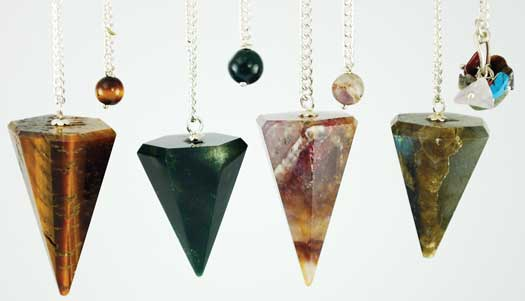

Assorted Faceted 6-Sided Pendulum
$5.45
A Simple Faceted Pendulum for Dowsing
A six-sided faceted pendulum with a point, chosen at random from stock, used by practitioners for yes/no divination, dowsing and spirit questions.
Quick Uses
- Yes/No: Set your yes and no swings, then ask one clear question at a time.
- Dowsing: Hold it over a map or chart to find what you are looking for.
- Spirit Board: Use it over a pendulum board to spell out answers.
- Choosing: Dowse over candles, oils or cards to pick what a working needs.
How to Use It
Witchcraft & Folk Magick
- Dowse over herbs, stones and oils to choose ingredients for a spell.
- Use it over a map to look for lost things or good places to work.
Hoodoo & Rootwork
- Check whether a candle working has been received by asking yes or no.
- Dowse over a list of roots and curios to choose what to use.
Demonology & Black Magick
- Ask yes/no questions of a spirit inside a prepared ritual space and record each answer.
- Dowse over a sheet of seals or sigils to find which spirit to approach.
A Simple Working
- Light a white candle and a little frankincense.
- Pass the pendulum through the smoke and say that it is now a tool of true answers.
- Hold it still and ask it to show yes, then no, noting each swing.
- Ask a few questions you already know the answers to.
- Write the swings in your journal.
- Keep the pendulum in a small pouch with a pinch of frankincense.
Pairs Well With
- A pendulum board, for spelling out longer answers.
- Frankincense, for consecrating the pendulum.
- A small cloth pouch, to keep it clean between uses.
- A journal, to record each question and answer.
What You Receive
One faceted six-sided pendulum with a point, selected at random from available stock. Approximately 7 1/2″ long.
Origin & Lore
The pendulum’s first use was for finding things: water, minerals and lost objects. Its use for answering questions grew out of the same practice, with the swing read for yes and no.
Hand-held pendulums became popular in European dowsing in the 19th and 20th centuries, and are now one of the most common divination tools on the practitioner’s altar.
Did You Know?
Georgius Agricola described dowsing with forked rods for finding metal ores in his mining treatise De re metallica, published in 1556.
| Weight | 0.04 lbs |
|---|
Related products