


Black Embossed Leather Journal with Key & Cord
$40.65
Locked By Cord And Key
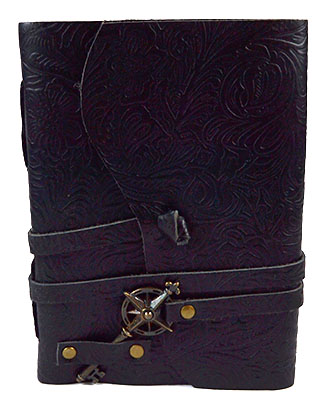
A 5″ x 7″ soft black leather journal embossed with flowers and leaves, wrapped by a long cord and finished with a decorative key in its own slot, for a grimoire you want sealed as well as kept.
Quick Uses
- Sealed grimoire: Wrap the cord and tie it with a knot each time you close the book.
- Knot magick: Tie your intention into the cord before setting the book on the altar.
- Key charm: Lift the key from its slot and hold it while you speak an opening prayer.
- Gift book: A handsome first book of shadows for a new practitioner.
How to Use It
Witchcraft & Folk Magick
- Tie a knot in the cord for each spell written in the book, binding the work inside.
- Press herbs and flowers from your garden between the pages beside the spells that call for them.
- Keep a sabbat section and note the date, weather and omens each year.
Ceremonial & Occult Magick
- Use it as a magickal record: date, planetary hour, rite performed and what you saw.
- Write out invocations and circle-casting texts so the book itself can be carried into the temple.
Demonology & Black Magick
- Keep it as a private grimoire: the spirits you work with, their seals, the offerings they accept and when.
- Log every pact, petition and offering with the date and hour, and note what was promised on both sides.
A Simple Working
- Lay the book on a black cloth with a stick of frankincense lit nearby.
- Remove the key from its slot and hold it in your writing hand.
- Ask Hecate, the keybearer, to guard the book and what goes into it.
- Write the date and your name on the first page.
- Return the key, wrap the cord three times and tie it with a knot.
- Leave the book on the altar overnight before first use.
Pairs Well With
- Frankincense: For consecrating the book.
- Key charms: To add to the cord for extra symbolism.
- Black chime candles: For dedication and closing rites.
- Rosemary: A protective herb to press inside the cover.
What You Receive
One 5″ x 7″ soft black leather journal with embossed floral and leaf designs, a long wrap-around cord and a decorative key that sits in a dedicated slot.
Origin & Lore
Keys have guarded magickal knowledge for centuries, both literally and in name. The most famous ritual manuscripts of the Renaissance are titled as keys, meant to open the art only to those prepared for it.
A blank book like this was traditionally made personal by the practitioner: dedicated, written in by hand and kept closed to others.
Did You Know?
The Key of Solomon, the Clavicula Salomonis, takes its Latin title from clavicula, little key, and survives in many manuscripts copied from the fifteenth century onward.
| Weight | 1 lbs |
|---|
Related products


