Black Moon & Star Ceramic Chime Candle Holder
$5.45
A Night-Sky Holder for Chime Candles
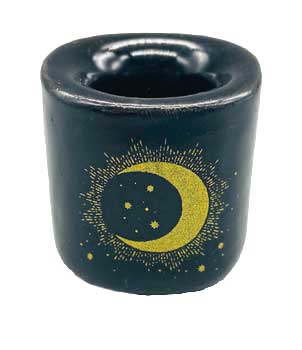
A glossy black glazed ceramic chime holder marked with the moon on its face, chosen by witches who want a small, dedicated seat for night and lunar candle work.
Quick Uses
- Moon Spells: Burn a silver or white chime in it on the full moon.
- Dream Candle: Light a short candle in it before sleep to ask for a dream.
- Night Ward: Burn a black chime in it on the dark moon for protection.
How to Use It
Witchcraft & Folk Magick
- Burn a white chime in it on a Monday, the moon’s day, to bless a new divination tool.
- Keep it on the nightstand altar and light a lavender-dressed chime before dream work.
Hoodoo & Rootwork
- Burn a black chime in it set over a petition to keep trouble away from the home at night.
- Use it to light a short work for psychic vision, the candle dressed with a dab of oil and a pinch of mugwort.
Ceremonial & Occult Magick
- Use it as the lamp for Monday hour work under the Moon, with a silver chime.
- Light it during astral or pathworking sessions as a fixed point to return to.
Demonology & Black Magick
- Burn a black chime in it as a small night offering to a spirit of the moon or of witchcraft.
- Place it at the edge of a sigil on the dark moon to mark the time of a call.
A Simple Working
- Before bed, dress a white or silver chime candle with a light oil.
- Seat it in the holder on your nightstand.
- Lay a sprig of dried mugwort or a bay leaf beside it.
- Light the candle and ask the moon for a dream that answers your question.
- Sit quietly until the candle burns down.
- Slip the herb under your pillow and go to sleep.
- Write down what you remember on waking.
Pairs Well With
- White Chime Candles: Simple lunar candles for this holder.
- Mugwort: Traditional for dreams and vision.
- Moonstone: A lunar stone for the night altar.
- Dream Journal: To record what comes.
What You Receive
One glossy black glazed ceramic chime candle holder with a moon symbol on the front. Fits 1/2″ chime candles. Candle not included.
Origin & Lore
This is a small holder made to keep a chime candle upright during a spell, here glazed black and marked with the moon for night work.
The crescent moon paired with a star is one of the oldest celestial emblems, found on Mesopotamian seals and on the coins of ancient Byzantium.
In modern witchcraft the moon belongs to the goddess, a link that Charles Leland’s Aradia, or the Gospel of the Witches (1899) made central by naming Diana as queen of the witches.
Did You Know?
The crescent and star appeared on coins of the city of Byzantium centuries before the Ottoman era.
Related products