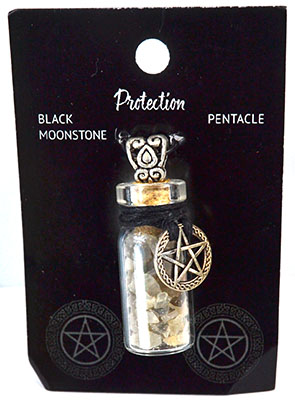
Black Moonstone Chip Bottle Necklace with Pentagram Charm
$4.35
Night Stone Under The Star
A tiny glass vial of black moonstone chips hung with a pentagram charm, worn by witches who want a lunar ward that travels with them.
Quick Uses
- Dark Moon Ward: Hold the bottle at the dark moon and name what it is to keep away from you.
- Scrying Aid: Wear it while you gaze into a black mirror or bowl of water to steady the trance.
- Night Charm: Hang it on the bedpost so the pentagram faces the door while you sleep.
How to Use It
Witchcraft & Folk Magick
- Charge the vial on a windowsill under the dark moon, then wear it as a protective amulet through the month.
- Trace the pentagram charm with a fingertip at each quarter of the moon to renew the ward.
Ceremonial & Occult Magick
- Wear it during the banishing pentagram ritual so the charm matches the figure you draw in the air.
- Keep it on during lunar workings timed to the planetary hour of the Moon.
Demonology & Black Magick
- Wear it during evocation as a personal seal of protection, pentagram facing outward from the chest.
- Rest the vial on a spirit’s sigil during night offerings to hold your intent in the room.
A Simple Working
- Wait for the dark moon and light a black chime candle.
- Hold the bottle in both hands over the flame at a safe height.
- State aloud what you are shielding yourself from.
- Turn the bottle so the pentagram faces you and breathe on it three times.
- Let the candle burn down.
- Wear the necklace from that night until the next dark moon.
Pairs Well With
- Black Chime Candles: Small enough to burn down in one sitting for a dark moon charging.
- Mugwort: A classic lunar herb to burn as you scry while wearing the bottle.
- Black Scrying Mirror: Matches the dark, lunar character of the stone for divination.
- Protection Oil: A dab on the cord renews the ward between moons.
What You Receive
One glass vial bottle necklace filled with black moonstone chips, finished with a pentagram charm. The bottle measures about 1 1/2″ and comes on a long cord. Natural stone chips vary in size, colour and shape.
Origin & Lore
Moonstone is a feldspar mineral, and the darker stones sold as black moonstone are feldspars showing the same soft sheen against a grey to black body. Its long association with the Moon comes from that floating light.
The pentagram has been a protective figure for centuries; Agrippa’s Three Books of Occult Philosophy (1533) drew the human body within it, and the Golden Dawn built its banishing rite around it.
Did You Know?
The glow on moonstone is called adularescence, named after Mount Adula in Switzerland, where the moonstone variety adularia was first described.
Related products