


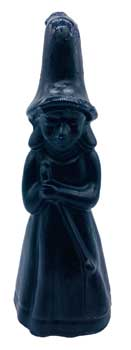
Black witch candle, 8″
$14.25
A witch candle for the Samhain altar
A black witch figure candle holding a pumpkin, made for the Samhain altar and work with the dead and ancestors.
Quick Uses
- Samhain: light her on 31 October beside photographs of the dead and a plate of food left out for them.
- Ancestors: burn her to honour those executed in the witch trials or the cunning folk of your line.
- Scrying: light her beside a mirror or bowl of dark water for scrying on Samhain night.
- Circle: stand her at the edge of a circle during ancestral rites as a light for the dead.
How to Use It
Witchcraft & Folk Magick
- Samhain altar: light her on 31 October beside photographs of the dead and a plate of food left out for them.
- Witch ancestors: burn her to honour those executed in the witch trials or the wise women and cunning folk of your line.
- Divination: light her beside a mirror or bowl of dark water for scrying on Samhain night.
Ceremonial & Occult Magick
- As a black candle she can stand at the edge of a circle during necromantic or ancestral rites as a light for the dead.
A Simple Working
- On Samhain night, set the candle on a dark cloth beside photos of the dead.
- Place a small plate of bread and an apple in front of her.
- Light the candle and speak the names of those you want to remember.
- Sit quietly and listen for a while.
- Let her burn for an hour and snuff her out.
- In the morning, leave the bread and apple outside for the birds.
Pairs Well With
- An apple: the classic Samhain offering for the dead.
- A black scrying mirror: for Samhain divination.
- Mugwort: for dreams and seeing on the night of the dead.
- A white chime candle: for each ancestor you name.
What You Receive
One 8″ black witch candle, moulded as a witch holding a pumpkin, with a wick embedded through the full length. Sizes may vary slightly.
Origin & Lore
Witch candles like this are modern seasonal pieces, but they draw on the old observance of Samhain, the Gaelic festival at the end of October that marked the start of winter and became Halloween. Black ties the figure to night, the dead and protection. In ritual use she is often set on an ancestor altar to honour witches who came before.
A witch standing with a pumpkin in hand is pure autumn: the season when, in Celtic lands, the veil between the living and the dead was held to be thinnest.
The jack-o’-lantern began in Ireland and Scotland as a lantern carved from a turnip or swede and carried at Halloween. Irish and Scottish immigrants in North America switched to the native pumpkin, which was bigger and easier to carve, and the pumpkin became the emblem of the season.
Did You Know?
Pumpkins are native to the Americas; they were unknown in Europe until after Columbus, so the Samhain lanterns of medieval Ireland could not have been pumpkins.
| Weight | 1.3 lbs |
|---|
Related products


