


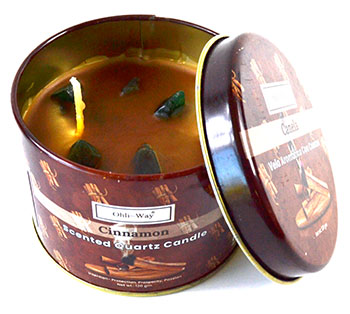
Canela (Cinnamon) tin candle
$10.95
A cinnamon candle for money and passion
A cinnamon-scented tin candle with crystal chips, burned for prosperity, desire and protection.
Quick Uses
- Money: set a dollar bill folded towards you under the tin and burn it on Sundays or Thursdays.
- Business: burn it by the till or shop door on opening day to draw customers.
- Speed: light it beside a slower money candle to hurry a result along.
- Passion: burn it in the bedroom with two cinnamon sticks tied crosswise in red thread on the lid.
How to Use It
Hoodoo & Rootwork
- Money drawing: set a dollar bill folded towards you under the tin and burn the candle on Sundays or Thursdays for prosperity.
- Business: burn it by the till or the front door of a shop on opening day to draw customers.
- Speed: light it beside a slower-burning money candle to hurry a result along.
Witchcraft & Folk Magick
- Passion: burn the candle in the bedroom with two cinnamon sticks tied crosswise with red thread on the lid.
- Protection of the home: a little ground cinnamon sprinkled on the doorstep while the candle burns inside.
A Simple Working
- On a Sunday morning, fold a banknote towards you three times.
- Lay it under the tin with a cinnamon stick on top of it.
- Light the candle and say what money you are asking for and what it is for.
- Burn for an hour, then snuff with the lid.
- Repeat each Sunday and Thursday until the candle is spent.
- Carry the cinnamon stick in your wallet afterwards.
Pairs Well With
- Cinnamon sticks: for the lid, the wallet and the doorstep.
- Money Drawing oil: to dress the banknote.
- A green chime candle: for a matching money burn.
- Pyrite: a coin-coloured stone for the money altar.
What You Receive
One cinnamon-scented Canela candle with crystal chips, poured in a tin with a lid, 120 g.
Origin & Lore
Cinnamon is the inner bark of trees of the genus Cinnamomum, native to Sri Lanka and southern Asia, and one of the oldest spices traded to the Mediterranean. Under the name canela it is a staple of Mexican cooking, from café de olla to rice pudding, and of the botánica, where its heat is linked with drawing money, speeding things up and stirring desire.
Herodotus was told that cinnamon came from the nests of giant birds in Arabia, and that men lured them with chunks of ox meat to bring the nests crashing down.
The holy anointing oil of Exodus 30 includes sweet cinnamon among its ingredients, alongside myrrh, cane and cassia, and the spice was burned and worn as a perfume across the ancient world. Ceylon cinnamon, Cinnamomum verum, has a soft, papery bark; much of what is sold as cinnamon is the harder, stronger cassia.
Did You Know?
Cinnamon’s warm smell and taste come mostly from a single compound, cinnamaldehyde, found in the bark’s oil.
| Weight | 0.4 lbs |
|---|
Related products


