



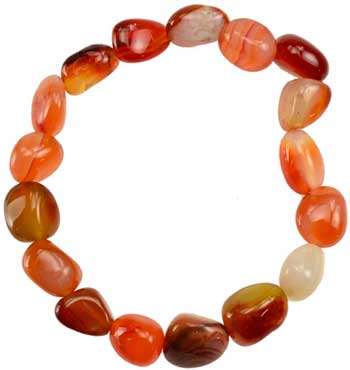

Carnelian Bead Bracelet (3/8″)
$6.55
A Quiet Ember on the Wrist
A simple elastic bracelet of 3/8″ carnelian beads, worn by practitioners as an understated focus for courage, drive and meditation.
Quick Uses
- Meditation Focus: Rest your attention on one bead at a time during a short sit.
- Courage: Wear it to any test, trial or performance.
- Daily Fire: Put it on with your work clothes to keep your drive steady.
- Protection: Wear it as a traditional amulet stone close to the skin.
How to Use It
Witchcraft & Folk Magick
- Charge it in Sunday sunlight and wear it for a week of focused work.
- Use it as a counting string for a short daily chant of strength.
- Wear it during spells for creative breakthrough, touching a bead each time an idea arrives.
Hoodoo & Rootwork
- Keep it in your pocket with a High John root on job-hunting days, wearing it into the interview.
- Dress it with a drop of courage oil before a confrontation.
Ceremonial & Occult Magick
- Wear it during solar workings for vitality and success.
- Hold it while charging talismans of Mars or the Sun.
Demonology & Black Magick
- Wear it as a protective amulet during evocation, as carnelian has been an amulet stone since antiquity.
- Offer it to a spirit of fire or war as a warm token when asking for courage.
- Wear it when you must stand your ground in a negotiation with a spirit, as a reminder of your own fire.
A Simple Working
- Sit facing east in the morning with the bracelet in your hand.
- Light an orange candle on a heatproof dish.
- Touch each bead and name one strength you already have.
- When you reach the last bead, name the challenge in front of you.
- Put the bracelet on while the candle still burns.
- Snuff the candle and carry on with your day.
Pairs Well With
- Orange Candles: For courage, energy and success.
- High John Root: A traditional hoodoo root for conquering and strength.
- Courage Oil: For dressing before hard days.
- Tiger Eye: Adds steady protection to the fire.
What You Receive
One elastic bracelet of carnelian beads averaging about 3/8″ each (stones vary slightly), one size fits most, measuring about 3″ across.
Origin & Lore
Carnelian is one of the oldest amulet stones, worn in ancient Egypt and Mesopotamia for protection and vitality. Its warm orange glow has kept it tied to courage and the fire of life.
Carnelian beads from the Indus Valley Civilisation, made in what is now Pakistan and India, have been found in Mesopotamian royal tombs at Ur, showing how widely the stone was traded over four thousand years ago.
Did You Know?
Etched carnelian beads made in the Indus Valley were traded as far as the royal tombs of Ur in Mesopotamia.
Related products


All Jewelry