

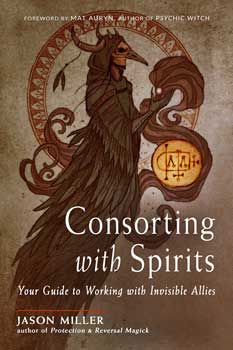


Consorting with Spirits by Jason Miller
$24.15
A Working Manual For Spirit Contact
A practical guide to perceiving, contacting and building lasting working relationships with spirits, read by anyone who wants clearer contact rather than one-off conjurations.
Quick Uses
- Perception Practice: Work its perception exercises daily for a month before attempting a full evocation.
- Spirit Journal: Log every contact, offering and response in a dedicated notebook as you read.
- Relationship Building: Choose one spirit and use the book’s approach to keep regular offerings going with it.
How to Use It
Witchcraft & Folk Magick
- Set up a small spirit shelf and use the book’s ideas on relationship to keep a weekly offering schedule.
- Practise its perception skills at a crossroads or graveside, noting what you sense before you look for signs.
Ceremonial & Occult Magick
- Read its classifications of spirits before you work any grimoire, so you know what kind of being you are calling.
- Pair its communication methods with your usual circle and incense, and keep a record of each session.
Demonology & Black Magick
- Use its focus on negotiation to plan exactly what you will offer and ask before calling a Goetic spirit.
- Return to the same spirit over months, as the book encourages, rather than calling and dismissing a new one each time.
A Simple Working
- Choose one spirit you already have some contact with.
- Light a white chime candle and burn a little frankincense resin.
- Sit quietly for ten minutes and note anything you perceive.
- Speak to the spirit plainly, and make your offering.
- Ask one clear question and wait.
- Write down every impression before you close, then thank the spirit.
Pairs Well With
- Frankincense Resin: A classic offering and temple incense for spirit work.
- White Chime Candles: Simple, quick-burning lights for regular sessions.
- Blank Journal: For keeping a running record of each spirit relationship.
- Black Tourmaline: Kept on the altar as a grounding stone between sessions.
What You Receive
One copy of Consorting with Spirits by Jason Miller, a 6.08″ x 9.05″ paperback with 240 pages.
Origin & Lore
The book sets out what spirits are, how they are classified and how they relate to the everyday world, then gives a practice built around three skills: seeing spirits clearly, dealing with them well and deepening the bond over time. Its stress is on long relationships and clean communication rather than single dramatic summonings.
Contact with spirits is one of the oldest threads in magick. Greek magical papyri describe binding a spirit assistant, the paredros, and the medieval and Renaissance grimoires built whole systems on calling, constraining and bargaining with angels and demons.
Did You Know?
In Greek, a daimon was simply a spirit or divine power, not necessarily an evil one; Socrates spoke of a daimonion, an inner voice that warned him away from mistakes.
Related products