


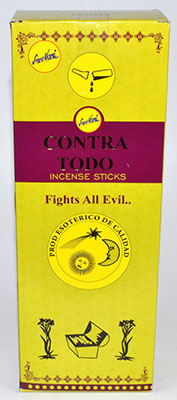
Contra Todo (Against All) incense sticks
$9.85
A Latin American guard against all harm
Stick incense in the Contra Todo tradition, made to guard against every kind of harm at once, from envy and witchcraft to bad luck.
Quick Uses
- Despojo: pass the smoke over a person after an herb or egg cleansing to seal the work.
- Caravaca cross: burn it before a Cruz de Caravaca and pray for protection from every harm.
- Saturday cleansing: smoke the home each Saturday, finishing at the front door.
- Unknown crossing: burn it with a white candle and ask that every cross be lifted, whatever its source.
How to Use It
Folk Catholicism & Spiritism
- Despojo: after a cleansing with herbs or an egg, light a stick and pass the smoke over the person to seal the work.
- Caravaca cross: burn it before a Cruz de Caravaca, the double-barred cross of Spanish folk devotion, and pray for protection from every harm.
- Saturday cleansing: smoke the home each Saturday, finishing at the front door.
Hoodoo & Rootwork
- Unknown crossing: when you cannot tell who or what is working against you, burn it with a white candle and ask that every cross be lifted regardless of where it came from.
- Returning harm: some workers burn it with a reversing candle, asking that anything sent be sent back to its source.
A Simple Working
- Fill a bowl with water and add a handful of rue or basil and a pinch of salt.
- Light a white candle and one stick of Contra Todo incense.
- Dip your fingers in the water and touch your forehead, chest and hands.
- Say “Against all harm, against all envy, against all witchcraft.”
- Pass the smoke over yourself from head to feet.
- Pour the water out at the street or the edge of your property.
Pairs Well With
- Caravaca cross: the traditional Spanish amulet against all harm.
- Rue: the classic herb of Latin American cleansings.
- White candle: for cleansing and lifting crosses.
- Reversing candle: to send harm back.
What You Receive
Contra Todo (Against All) stick incense, a box of 6 packs with 20 sticks in each (120 sticks).
Origin & Lore
Contra Todo is a modern formula from Latin American botánica practice, a broad protective and uncrossing blend used when the source of trouble is unknown or there is more than one. It is burned during and after a despojo, a spiritual cleansing that strips off negativity, and in homes and businesses as a standing guard.
Contra Todo means Against All, and it is meant literally: one smoke for witchcraft, envy, bad luck, enemies and whatever else has crept into the house.
The Cruz de Caravaca takes its name from Caravaca de la Cruz in Murcia, Spain, where legend says a double-armed cross was brought by angels in 1232 so that a captive priest could say Mass before a Moorish ruler. The cross became a widely carried amulet in Spain and Latin America, worn against storms, sickness, witchcraft and the evil eye.
Did You Know?
Caravaca de la Cruz is one of the few places granted a perpetual jubilee year by the Catholic Church, celebrated every seven years since 2003.
| Weight | 0.8 lbs |
|---|
Related products


