



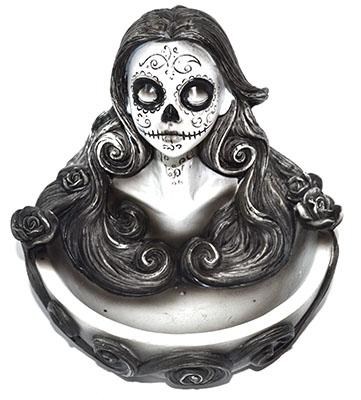
Day of the Dead Lady Incense Holder (4 1/2″)
$28.55
A Dark Lady for Your Ancestor Altar
A 4 1/2″ Day of the Dead incense holder of a female figure with flowing smoky gray, black and silver hair, chosen to keep incense rising on altars for the beloved dead.
Quick Uses
- Ancestor Offering: Burn incense in it on your ancestor altar each week.
- Día de Muertos Altar: Set it on your ofrenda alongside marigolds and photos.
- Spirit Call: Burn a stick in it while you speak the names of your dead.
How to Use It
Witchcraft & Folk Magick
- Set it on your ancestor altar and burn incense each Samhain while you read their names aloud.
- Place it beside photographs and burn a stick as a quiet offering to the dead.
Hoodoo & Rootwork
- Burn incense in it on a Monday for the ancestors and leave a glass of water beside it.
- Use it on a graveyard dirt altar when asking a spirit of the dead for help.
Ceremonial & Occult Magick
- Burn a stick in it during a rite of Hecate or Persephone to honour the queen of the dead.
- Keep it on the altar while working with the dead through a crystal or mirror.
Demonology & Black Magick
- Burn incense in it as an offering in necromantic work with a known spirit of the dead.
- Set it on the altar of a death spirit and burn a stick before each request.
A Simple Working
- On a Monday night, light a white chime candle on your ancestor altar.
- Set the holder in front of a photo or the name of one ancestor.
- Light a stick of copal or myrrh incense in it.
- Place a few marigold petals or a flower beside it.
- Speak their name and tell them what has happened in your life.
- Ask for their guidance and let the candle burn out.
Pairs Well With
- Copal Resin: The traditional incense of Mexican altars for the dead.
- White Chime Candles: Simple lights for ancestor offerings.
- Marigold Flowers: The flower of Día de Muertos.
- Myrrh Resin: An old incense for the dead.
What You Receive
One 4 1/2″ Day of the Dead incense holder featuring a female figure with long, flowing hair in smoky gray, black and silver tones.
Origin & Lore
This holder draws on the art of Día de Muertos, the Day of the Dead, celebrated in Mexico on 1 and 2 November, when families build ofrendas to welcome their dead home. These altars are first a place of offering, and copal incense is traditionally burned on them along with marigolds, candles, food and photographs.
The elegant skeletal lady seen in Day of the Dead art goes back to La Calavera Catrina, an etching by José Guadalupe Posada from the early 1900s. Diego Rivera later painted her in his mural Dream of a Sunday Afternoon in Alameda Park, and she became one of the festival’s best known figures.
Did You Know?
The famous Day of the Dead lady, La Catrina, began as a satirical etching by José Guadalupe Posada in the early 1900s.
Related products


