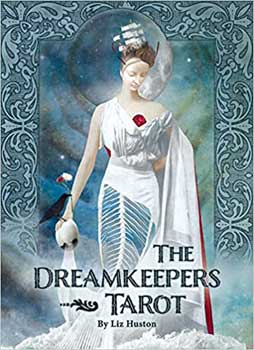
Dreamkeepers Tarot by Liz Huston
$31.85
Tarot as a Mirror of Dreams
A Rider-Waite-inspired tarot built from layered paint and photographic montage, chosen by readers who use the cards to look at hidden motives, beliefs and dream images.
Quick Uses
- Pillow card: Choose a card before bed and sleep with it under your pillow to ask for a dream on its theme.
- Motive check: Draw one card to see what really drives a choice you are about to make.
- Dream reading: After a vivid dream, draw a card to help interpret what it showed you.
- Healing draw: Lay three cards for wound, lesson and remedy when something old resurfaces.
How to Use It
Witchcraft & Folk Magick
- Read with a cup of mugwort tea before bed and keep the deck on the nightstand to tie it to your dreaming.
- Use a card as the image for a dream pillow or charm, laid in the pouch with herbs.
Ceremonial & Occult Magick
- The deck follows the traditional structure, so it carries all the usual Golden Dawn correspondences for lunar and astral work.
- Use a card as a doorway for astral travel, holding its image until you can step into the scene.
Demonology & Black Magick
- Ask a spirit you work with to show itself in a dream, then read the cards on waking to interpret what came.
- Draw before and after an evocation to check the timing and see the result.
- Use the deck to divine which spirit to approach when several might help with a matter.
A Simple Working
- On a night before sleep, make a cup of mugwort tea and light a white chime candle.
- Shuffle while stating the question you want answered in a dream.
- Draw one card and study it for a few minutes, noting every detail.
- Put the card under your pillow and snuff the candle.
- On waking, write down everything you recall before you get up.
- Draw two more cards and read them alongside the dream to complete the answer.
Pairs Well With
- Mugwort: drunk as tea or burned before sleep to strengthen dreams.
- A dream journal: to keep dreams and readings side by side.
- A moonstone: kept under the pillow with the card for lunar dreaming.
- A tarot bag: to protect the deck when it lives by the bed.
What You Receive
One tarot deck of 78 cards with a 180-page guidebook, in a 7 1/4″ x 5 1/4″ box.
Origin & Lore
Tarot began as an Italian card game in the 1400s and only became a tool of divination in eighteenth-century France. The Rider-Waite deck of 1909 gave every card a full scene and set the pattern most modern decks still follow.
Liz Huston builds on that tradition with art blending several paint media and digital photographic montage, treating the tarot as a mirror for inner truths, hidden motivations and expectations. This edition includes new art made for it.
Did You Know?
A. E. Waite’s companion book, The Pictorial Key to the Tarot, was published in 1910, the year after the deck it explains.
| Weight | 1.5 lbs |
|---|
Related products

Crystal Balls

Altar Supplies