


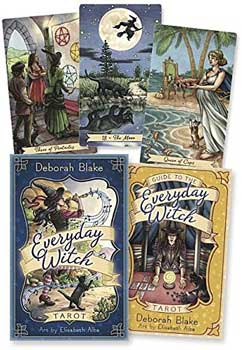


Everyday Witch Tarot by Deborah Blake
$36.29
A Practical Tarot for Working Witches
A Rider-Waite-based tarot full of black cats, pointed hats and brooms, chosen by witches who want a clear, friendly deck for daily reading and learning.
Quick Uses
- Daily draw: Pull one card at breakfast and see how it plays out by evening.
- Learning deck: Work through one card a day with the guidebook until you know all 78.
- Home reading: Draw a card for the household before a cleansing or blessing.
How to Use It
Witchcraft & Folk Magick
- Keep the deck on your kitchen altar and read before cooking a spell meal.
- Use a card as the focus of a simple candle spell, laid under the candle as it burns.
Hoodoo & Rootwork
- Draw a card to choose which condition oil or powder suits the job in hand.
- Read before and after laying a trick, to see if it is taking.
Demonology & Black Magick
- Read before a working to judge the timing, and after the spirit is dismissed to see the result.
- Ask a spirit to answer through the cards while you hold its seal in your left hand.
A Simple Working
- Light a white chime candle on your kitchen table.
- Burn a pinch of rosemary and pass the deck through the smoke.
- Shuffle while asking what your household needs this week.
- Draw three cards: what to clear, what to bring in, and what to protect.
- Read them with the guidebook and write a short to-do list from them.
- Sweep the front step afterwards, the oldest home spell of all.
Pairs Well With
- Rosemary: a kitchen-witch herb for clearing and protecting the home.
- White chime candles: for short daily readings.
- A blank book of shadows: to record your daily draws while you learn.
- A tarot bag: to keep the deck clean in a busy home.
What You Receive
One tarot deck of 78 cards with a full-colour 264-page guidebook.
Origin & Lore
Tarot began as a card game in fifteenth-century Italy and became a tool of divination in late eighteenth-century France. The Rider-Waite deck of 1909 set the pattern for most modern decks, this one included.
Deborah Blake updates that pattern for the modern witch with cats, hats and brooms, and her guidebook is written with a friendly, practical focus.
Did You Know?
Tarot cards were first called trionfi, meaning triumphs; the name tarocchi came into use in Italy in the early sixteenth century.
| Weight | 2 lbs |
|---|
Related products


Crystal Balls


Altar Supplies