


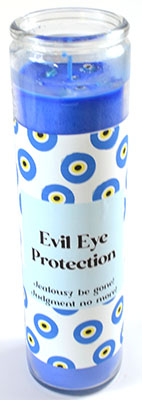

Evil Eye Protection scented jar candle
$21.95
A blue candle against envy
A blue ritual jar candle covered in evil eye symbols and topped with charms and selenite, burned to deflect envy and ill will.
Quick Uses
- Envy clearing: read the prayer aloud and burn it a few hours each day after good news shared widely.
- Charms: take an evil eye charm from the top once the wax has burned down and wear or carry it.
- Projects: set paperwork or a photo of a new venture beside the jar while it burns.
- Prayer: burn it with the Our Father or a prayer to Saint Michael.
How to Use It
Witchcraft & Folk Magick
- Envy clearing: light the candle and read the prayer aloud, then burn it for a few hours each day after a new job, a pregnancy or any good news shared widely.
- Charm charging: once the wax has burned down, take one of the evil eye charms from the top and wear or carry it.
- Project protection: set paperwork, a business card or a photo of a new venture beside the jar while it burns.
Folk Catholicism & Spiritism
- Burned with the Our Father or a prayer to Saint Michael, as many Mediterranean and Latin American households pair the eye charm with Christian prayer.
A Simple Working
- Wipe the jar with a cloth dampened in salt water.
- Place a photo of yourself, or of the person you want protected, beside it.
- Light the candle and read the prayer on the glass aloud.
- Say that every envious eye turned your way is turned back.
- Burn for a few hours a day until it is spent.
- Take a charm from the top and pin it inside a coat or hang it by the door.
Pairs Well With
- Evil Eye Protection oil: the matching oil for dressing the doorway.
- A nazar bead: to hang by the door or in the car.
- Rue: the Mediterranean and Latin American herb against the eye.
- Selenite: to set on windowsills for clean, bright protection.
What You Receive
One blue Evil Eye Protection ritual jar candle covered in the evil eye symbol, topped with evil eye charms and selenite, with a prayer on the glass; burns approximately 3 1/2 days.
Origin & Lore
Belief in the evil eye, the harm carried by an envious or admiring look, runs from the Mediterranean through the Middle East, North Africa, South Asia and Latin America. The blue eye charm, the Turkish nazar or Greek mati, is the best-known protection, and this candle builds that symbol into a protective light with a prayer on the glass.
The blue glass eye hangs in Turkish taxis, Greek kitchens and newborns’ cribs for the same reason: to stare back at envy before it lands.
The Greek writer Plutarch devoted a section of his Table Talk to the question of why some people are thought to cast the evil eye, and the Romans hung phallic fascinum charms on children to turn it away. In Greece, a family elder still often removes the eye, xematiasma, with a whispered prayer and drops of olive oil in a bowl of water.
Did You Know?
Selenite takes its name from Selene, the Greek goddess of the moon, for its soft, pearly sheen.
| Weight | 1.2 lbs |
|---|
Related products


