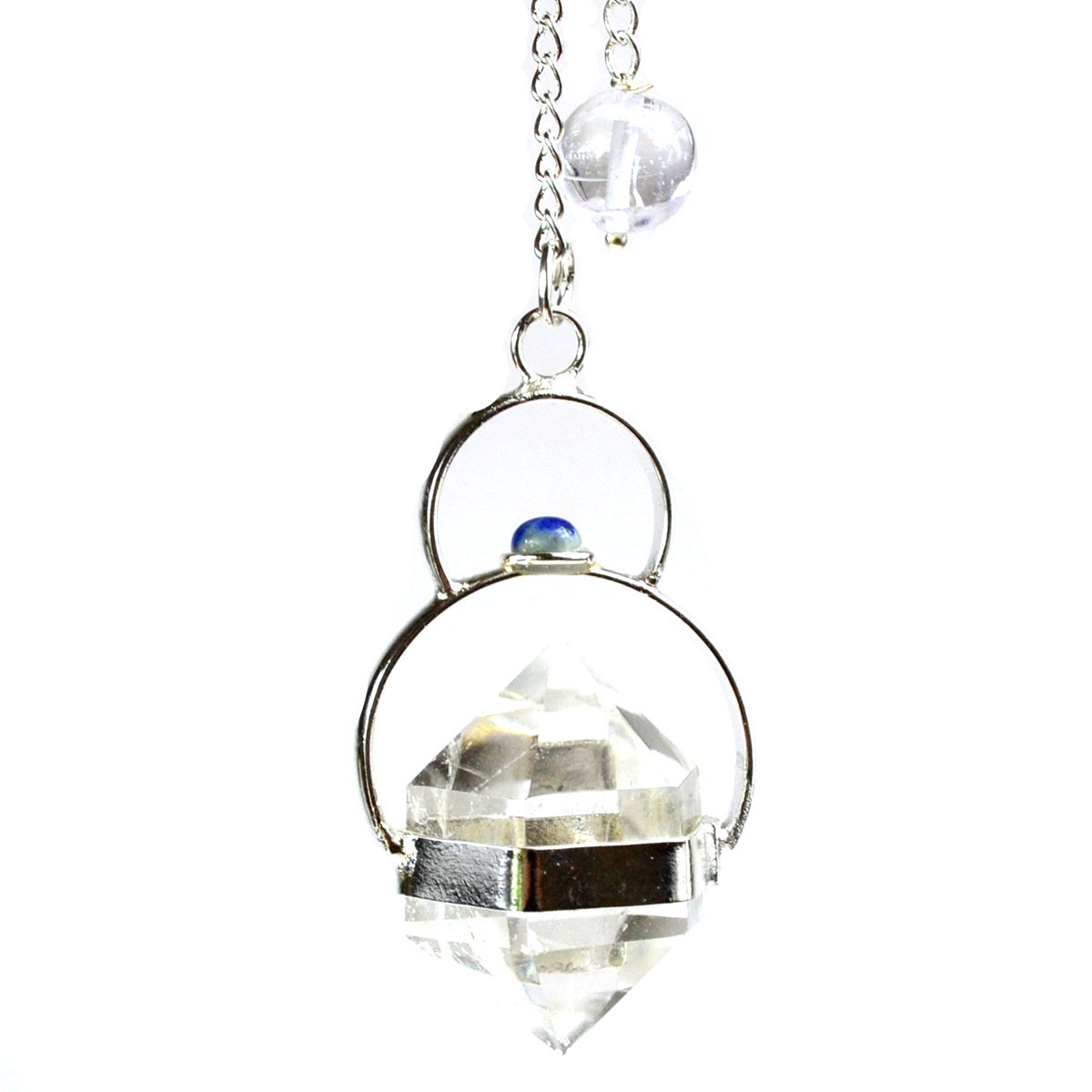
Faceted Clear Quartz Pendulum with Lapis Lazuli
$14.25
Clear Quartz Crowned With Lapis
A faceted clear quartz pendulum set with lapis lazuli in silver-toned rings, favoured by readers who want a bright, responsive stone with lapis’ old association with wisdom and royal favour.
Quick Uses
- Divination: Use it for yes/no work and chart dowsing, letting the faceted point give a crisp, readable swing.
- Study: Hold it over study notes or a list of texts and ask which to work with next.
- Blessing: Circle it clockwise over a candle or talisman to charge it before a working.
- Dream Questions: Ask a question before sleep, then dowse over your dream notes in the morning.
How to Use It
Witchcraft & Folk Magick
- Dowse over seed packets, herbs or crystals to see what your spellwork actually wants.
- Circle it over a finished charm bag to bless and seal it.
Ceremonial & Occult Magick
- Use it in planetary hours of Jupiter to dowse over matters of advancement, learning and patronage.
- Swing it over a talisman after consecration to confirm the charge has taken.
- Hold it over a Hebrew or Enochian letter chart when you want a spelled answer.
Demonology & Black Magick
- After calling a spirit into a triangle or onto a seal, ask it to answer yes or no through the pendulum’s swing.
- Dowse over a list of spirit names to divine which one is best suited to the petition in hand.
- Before a working, ask whether the offering you have prepared is acceptable; after it, ask whether the pact or petition has been received.
A Simple Working
- Set a blue candle and a dish of salt on your altar and light the candle.
- Pass the pendulum through the candle’s warmth, never the flame, and over the salt.
- Write your question in a single line on a slip of paper.
- Hold the pendulum over the paper and let it come to stillness.
- Speak the question three times and watch the swing.
- Record the answer, then fold the paper toward you if yes or away from you if no.
- Pinch out the candle and keep the paper under the salt dish until the matter resolves.
Pairs Well With
- A pendulum board: letters and numbers let the faceted point spell out fuller answers.
- Blue chime candles: match lapis for study, wisdom and clear-sight workings.
- Mugwort: burned or brewed before a session to sharpen inner sight.
- A silk cloth: to wrap the crystal and keep the facets clean.
What You Receive
One faceted clear quartz pendulum set in silver-toned rings with a piece of lapis lazuli. Total length approximately 8 1/2″, including a 7″ chain finished with a quartz bead.
Origin & Lore
Pendulums began as finding tools, used to locate water, ore and lost things, and only later became a staple of divination by chart, alphabet and map.
Lapis lazuli was among the most prized stones of the ancient world: it was carved into amulets and seals in Mesopotamia and inlaid in Egyptian funerary jewellery, including the burial mask of Tutankhamun.
Did You Know?
Ground lapis lazuli was the source of the pigment ultramarine, which in Renaissance Europe could cost more than gold and was often reserved for painting the robes of the Virgin Mary.
| Weight | 0.04 lbs |
|---|
Related products