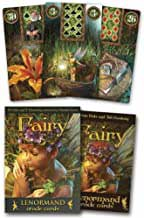
Fairy Lenormand Oracle by Katz & Goodwin
$21.95
36-Card Lenormand with Fairy Art
A Lenormand deck built on the original 36-card system with fairy art by Davide Corsi, chosen by readers who want clear, practical answers to everyday questions.
Quick Uses
- Three-card line: Lay three cards in a row and read them as a single sentence.
- Grand Tableau: Lay all 36 cards in a grid to see your whole situation at once.
- Yes or no: Draw two cards and read whether they lean positive or negative.
- Fairy offering: Read beside a small offering of honey or milk for the fair folk.
How to Use It
Witchcraft & Folk Magick
- Leave a little honey or milk out for the fair folk before reading and ask for their help.
- Use the Lenormand combinations to build simple charms: Clover and Sun for luck, Heart and Ring for love.
Hoodoo & Rootwork
- Read before a job to see where the trouble lies: the Fox for deceit, the Snake for a rival, the Mice for loss.
- Use a card as the picture of what you want, laid under a candle during a candle working.
Demonology & Black Magick
- Lenormand gives clear answers, so it suits quick questions put to a spirit during a ritual.
- Read before and after an evocation to check the timing and the result.
A Simple Working
- Set a small dish of honey or milk on your table for the fair folk.
- Light a white chime candle.
- Shuffle the 36 cards while asking a short, clear question.
- Lay three cards in a line and read them left to right as one sentence.
- Check the combinations in the guidebook to refine your reading.
- Leave the offering outside overnight and give thanks in the morning.
Pairs Well With
- Honey: a traditional offering to the fair folk.
- White chime candles: for short, focused readings.
- A tarot deck: to read alongside Lenormand for deeper questions.
- A blank journal: to track combinations and how they played out.
What You Receive
One Lenormand deck of 36 cards with a 192-page guidebook, in a 4.2″ x 6″ box.
Origin & Lore
Lenormand cards come from an eighteenth-century German parlour game and were later used for fortune-telling under the name of the famous French reader Marie Anne Lenormand. The 36-card system reads cards in pairs and lines like words in a sentence.
This deck keeps that original system with fairy art by Davide Corsi, and its guidebook is by Marcus Katz and Tali Goodwin, authors of Learning Lenormand.
Did You Know?
The 36-card Lenormand layout comes from Das Spiel der Hoffnung, the “Game of Hope,” a board game by Johann Kaspar Hechtel of Nuremberg published around 1799.
| Weight | 0.7 lbs |
|---|
Related products