


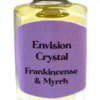
Frankincense & Myrrh oil (Espiritu blend)
Price range: $3.25 through $80.25
The two great sacred resins together · Available in 3 sizes
Frankincense and Myrrh oil pairs the two great sacred resins of the ancient world for blessing, spiritual healing work and consecration.
Quick Uses
- Healing work: dress a white or blue candle for spiritual healing and emotional restoration after a hard time.
- Consecration: anoint altar tools, crystals and candles to consecrate them.
- Petitions: anoint a petition for the wellbeing of someone you are praying for.
- Offerings: use as an offering to deities, saints and ancestors who receive incense.
How to Use It
Witchcraft & Folk Magick
- Dress a white or blue candle for spiritual healing and emotional restoration after a hard time.
- Anoint altar tools, crystals and candles to consecrate them.
Hoodoo & Rootwork
- Add to a blessing bath for spiritual strength and renewal.
- Anoint a petition for the wellbeing of someone you are praying for.
Ceremonial & Occult Magick
- Anoint the brow and hands before ritual as a classic temple dressing.
- Use as an offering to deities, saints and ancestors who receive incense.
- Consecrate talismans at both solar and lunar hours.
A Simple Working
- Place a white candle on your altar with a photo or the name of the person you are praying for.
- Anoint the candle from base to wick with the oil.
- Dab a little oil on the photo or name.
- Light the candle and pray or speak your wish for their wellbeing.
- Sit with the candle for a few minutes in silence.
- Let it burn down and keep the photo on the altar for seven days.
Pairs Well With
- Frankincense and myrrh resin, burned on charcoal alongside.
- A white candle, for blessing and spiritual renewal.
- Clear quartz, for amplifying a blessing.
- Rosemary, for cleansing before the blessing.
What You Receive
Frankincense & Myrrh oil, available in 2 dram, 1 oz and 16 oz bottles.
Origin & Lore
Frankincense and myrrh are the resins of Boswellia and Commiphora trees from Arabia and the Horn of Africa, burned together in temples and churches for thousands of years. Frankincense is traditionally linked to the Sun and myrrh to the Moon, so the blend joins the two lights for blessing, purification and spiritual restoration.
Gold, frankincense and myrrh: two of the three gifts the Magi carried to Bethlehem were resins, which says how precious these scents were.
Myrrh is named in Exodus as an ingredient of the holy anointing oil, and frankincense in the sacred incense of the Tabernacle.
Both resins were used in Egyptian temple ritual and myrrh was used in Egyptian embalming, which tied it to death and rebirth as well as to the sacred.
Did You Know?
The word myrrh is traced to an Arabic and Hebrew root meaning bitter, after the resin’s taste.
| Weight | N/A |
|---|---|
| Size | 2 dram, 1 oz, 16 oz |
Related products


