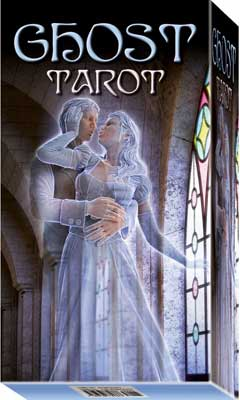

Ghost Tarot by Davide Corsi
$26.35
Tarot of the Restless Dead
A 78-card tarot set in the liminal world of ghosts, chosen by readers who work with the dead and want a deck that speaks their language.
Quick Uses
- Ancestor draw: Draw a card on an ancestor’s anniversary to hear what they want known.
- Ghost reading: Read for a restless spirit in a house to see what keeps it there.
- Graveyard card: Carry one card to a cemetery as a focus for contact.
How to Use It
Witchcraft & Folk Magick
- Read on an ancestor altar with a photo, a glass of water and a candle.
- Draw at Samhain, when the veil is held to be thin, for messages from the dead.
Hoodoo & Rootwork
- Read over graveyard dirt before using it, asking the spirit of the grave if it will work with you.
- Draw before and after laying a job that calls on the dead.
Demonology & Black Magick
- Use the deck in necromantic work: read before calling the dead, and ask the spirit to answer through the cards.
- Lay a card as the focal image of a working with the dead, beside their name or grave dirt.
- Read after the spirit is dismissed to see what remains.
A Simple Working
- On an ancestor altar, set a glass of water, a photo or name, and a white chime candle.
- Burn a little myrrh and call the ancestor by name three times.
- Shuffle and ask what they wish you to know.
- Draw three cards: what they saw, what they see now, and what they ask of you.
- Read the cards and speak your answer aloud to them.
- Pour the water onto the earth outside and let the candle burn out.
Pairs Well With
- Myrrh: the resin of the dead, burned for ancestor work.
- A black obsidian scrying mirror: for necromantic scrying after the cards.
- White chime candles: a simple light for the dead.
- Graveyard dirt: to tie a reading to a particular grave.
What You Receive
One tarot deck of 78 cards with a 64-page instructional booklet. The card stack measures 4 3/4″ x 2 5/8″ x 1″.
Origin & Lore
Tarot began as a card game in fifteenth-century Italy and became a divination tool in late eighteenth-century France. Death has had a trump of its own from the earliest decks.
Davide Corsi sets this deck in the liminal space between memory and the supernatural, the world of ghosts, where restless spirits search for their lost mortality.
Did You Know?
The Kennard Novelty Company of Baltimore began selling the Ouija board around 1890, and the patent was granted in 1891.
| Weight | 0.6 lbs |
|---|
Related products