


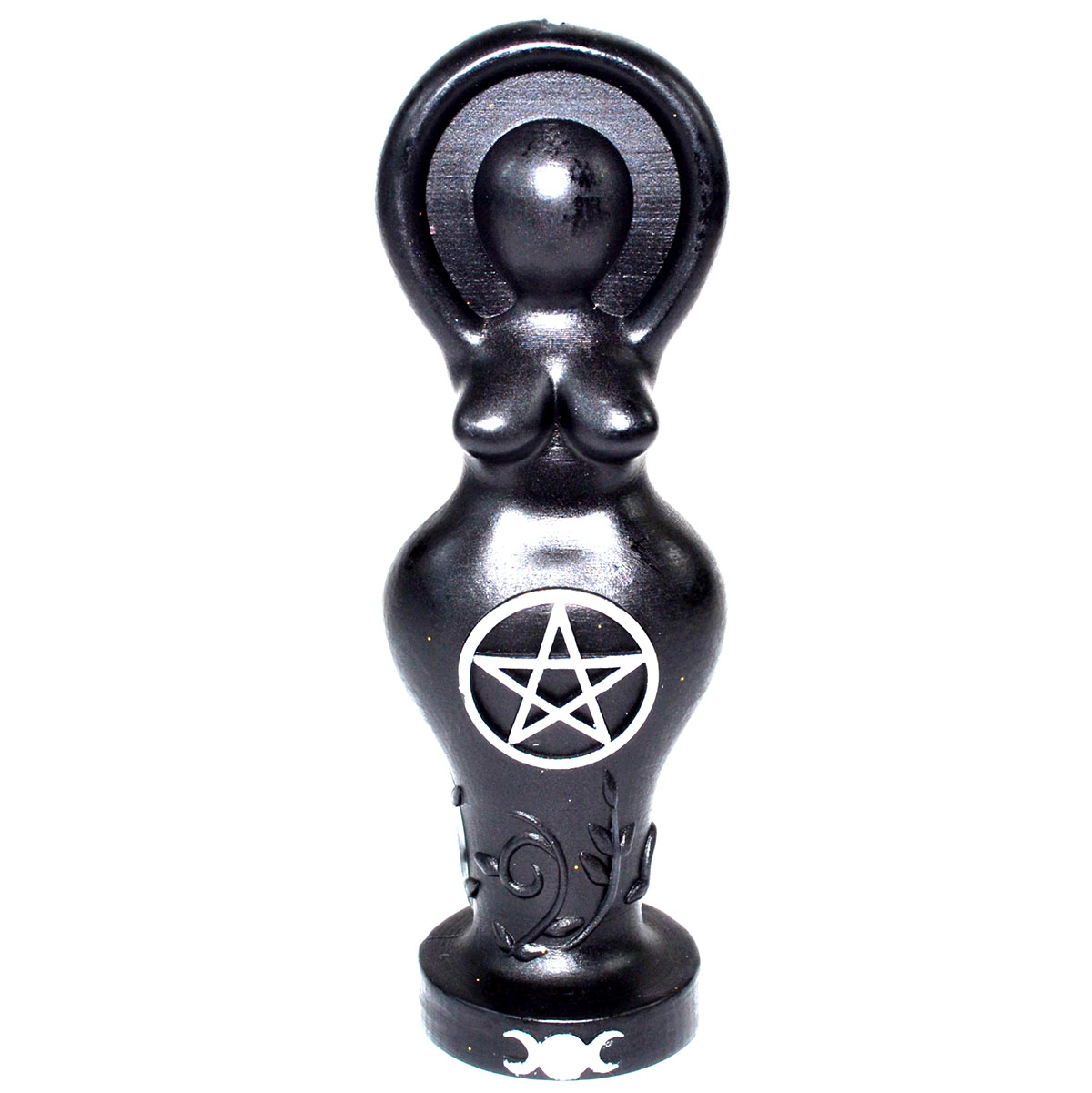
Goddess candle, 5 1/2″
Price range: $13.15 through $15.35
The Goddess light of the altar · Available in 4 sizes
A small standing Goddess figure candle, set on the Wiccan or pagan altar and burned for devotion, intuition and protection.
Quick Uses
- Altar: set her on the left of the altar, opposite a God candle, and light her to open the circle.
- Moon rites: burn the blue or purple Goddess on the full moon while drawing down or meditating.
- Dark moon: burn the black Goddess on the dark moon for banishing, protection and inner work.
How to Use It
Witchcraft & Folk Magick
- Altar light: set the Goddess candle on the left of the altar, opposite a God candle, and light it to open the circle.
- Moon rites: burn the blue or purple Goddess on the full moon while drawing down or meditating.
- Dark goddess work: burn the black Goddess on the dark moon for banishing, protection and inner work.
Ceremonial & Occult Magick
- As a single image of the feminine principle she can be placed in the West or the North in a ritual circle.
A Simple Working
- On the night of the full moon, set the candle on a small altar with a bowl of water.
- Light it and greet the Goddess by whatever name you use.
- Hold your hands over the bowl and ask for clear sight.
- Gaze into the water by candlelight for several minutes.
- Write down whatever comes to you.
- Snuff the candle and pour the water outdoors at the roots of a plant.
Pairs Well With
- A God candle: to balance the altar.
- A silver bowl: for full moon water.
- Mugwort: for seeing and dream work.
- A moonstone: to sit at her feet.
What You Receive
A Goddess figure candle about 5 1/2 to 6 inches tall, in black, blue, purple or chakra colours, burning for roughly 5 to 8 hours.
Origin & Lore
The Goddess candle is a modern pagan form, made to stand for the divine feminine on the altar in Wicca and Goddess spirituality. Black is chosen for the dark Goddess, the crone and protection; blue for the sea and moon; purple for spiritual power; and the chakra version for balancing work.
Many Wiccan altars hold two candles before anything else: one for the God and one for the Goddess, lit to open the rite.
The idea of a single great Goddess worshipped across prehistoric Europe was popularised in the 20th century by writers such as Robert Graves and the archaeologist Marija Gimbutas, and taken up by Wicca and the Goddess movement. Scholars argue over the history, but the image of the Goddess on the altar is central to modern pagan practice.
Did You Know?
The Venus of Willendorf, one of the most famous early female figurines, is about 11 cm tall and was carved roughly 30,000 years ago; it was found in Austria in 1908.
| Weight | N/A |
|---|---|
| Option | Black, Blue, Purple, Chakra |
Related products


