



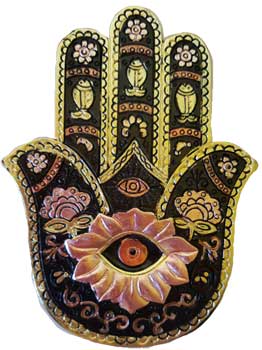
Gold & Black Hamsa Incense Burner
$14.25
Hamsa Hand Against the Evil Eye
A flat resin hamsa hand in black and gold with an incense hole in the eye at its palm, used by practitioners to ward off the evil eye with every stick they burn.
Quick Uses
- Evil Eye Ward: Burn incense in the palm whenever you feel watched or envied.
- Home Blessing: Set it near the entry and light a stick each week.
- Uncrossing: Burn a cleansing stick over it after a run of bad luck.
How to Use It
Witchcraft & Folk Magick
- Burn a protective incense in the palm’s eye on Sunday and let the smoke rise from the hand over your home.
- Lay a blue eye bead beside it as a doubled ward against envy.
Hoodoo & Rootwork
- Burn an uncrossing incense in it while you wash your doorstep with a cleansing floor wash.
- Set it on a reversal altar and burn a stick as you send back the evil eye.
Ceremonial & Occult Magick
- Use it as an incense station during protective rites with the five fingers set to the five elements and points of the pentagram.
- Burn incense in it during the consecration of a protective talisman.
Demonology & Black Magick
- Set it at the edge of your workspace during spirit work as a ward against unwanted attention.
- Burn a stick in it before uncrossing yourself after hexing or heavy black magick.
A Simple Working
- Set the hamsa on your altar with a blue chime candle beside it.
- Light the candle and place a stick of protection incense in the palm.
- Light the incense and hold your own palm toward it.
- Say that the eye of envy and the eye of harm are turned away.
- Sprinkle a pinch of sea salt around the base of the hand.
- Let the candle and incense burn out, then sweep the salt out your front door.
Pairs Well With
- Protection Incense Sticks: To burn in the palm.
- Blue Chime Candles: For warding and evil eye work.
- Evil Eye Beads: A traditional companion charm.
- Sea Salt: For cleansing and lines of protection.
What You Receive
One flat hamsa hand incense burner in tooled resin, black with gold detailing, with an incense hole in the centre of the eye on the palm. Measures 5″ long by 3 1/2″ wide tip to tip.
Origin & Lore
The hamsa’s original purpose is protection. It is a hand-shaped amulet hung in homes and worn as jewellery to turn away the evil eye.
The name comes from the Arabic word for five. It is found across North Africa and the Middle East, called the Hand of Fatima in Muslim communities and the Hand of Miriam in Jewish ones, and an eye is often set in the palm to stare back at envy.
Did You Know?
The word hamsa comes from the Arabic for five, after the five fingers of the hand.
Related products


