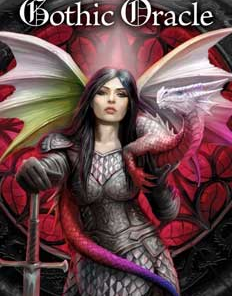


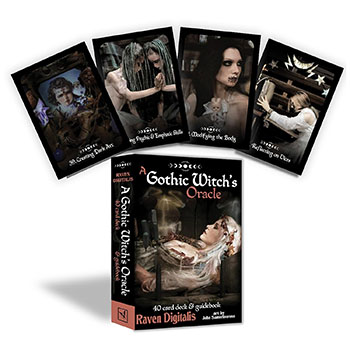
Gothic Witch’s Oracle by Digitalis & Santerineross
$32.95
Shadow Oracle For Dark Witches
A 40-card oracle made for shadow work and dark-path witchcraft, reached for by readers who want a deck that does not flinch.
Quick Uses
- Shadow Work: Draw a card to name what you are avoiding, then journal on it honestly.
- Dark Moon Reading: Read on the dark moon, when the deck’s mood suits the sky.
- Spell Prompt: Let a drawn card suggest the colour, herb or timing of your next working.
- Creative Divination: Read the images intuitively, using the guidebook only as a second opinion.
How to Use It
Witchcraft & Folk Magick
- Read at the dark moon to ask what must be cut away before the next cycle.
- Lay a card on a banishing altar beneath a black candle to name what you are sending off.
Ceremonial & Occult Magick
- Use cards as prompts for scrying: stare at the image in dim light until scenes move behind it.
- Pair a reading with a Saturnian rite on a Saturday for binding or endings.
Demonology & Black Magick
- Read before and after a necromantic or demonic working to gauge the presence and its mood.
- Ask a familiar spirit to choose a card in reply to a question, then keep its answer in your pact records.
- Use a drawn card as the focal image for a curse or hex, laid under a black candle with graveyard dirt.
A Simple Working
- On the dark moon, light a black chime candle and burn a little myrrh.
- Hold the deck to your chest and name the shadow you wish to face.
- Draw one card for the shadow, one for its root, and one for how to work with it.
- Sit with each image in the candlelight before reading the guidebook.
- Write what came up, unedited, in your journal.
- Pinch out the candle and bury the wax at a crossroads or the edge of your property.
Pairs Well With
- Myrrh resin: a heavy, traditional smoke for dark and funerary work.
- Black chime candles: for dark moon and banishing readings.
- Obsidian: kept with shadow decks as a Saturnian stone.
- Graveyard dirt: for laying a drawn card into necromantic or hexing work.
What You Receive
One oracle deck of 40 cards with an accompanying guidebook.
Origin & Lore
Oracle decks are freer than tarot: they keep no fixed structure, so each creator builds a set of images and meanings around a theme. Card divination itself is old, but decks made purely for reading, rather than for play, appear in eighteenth-century France.
This deck is built around shadow exploration, the idea that the dark and unseen parts of the self are part of the witch’s path, and it asks the reader to bring intuition to every card.
Did You Know?
The first deck designed specifically for divination is usually credited to the Parisian occultist Etteilla (Jean-Baptiste Alliette), who issued his own cartomancy deck around 1789.
| Weight | 1.3 lbs |
|---|
Related products