

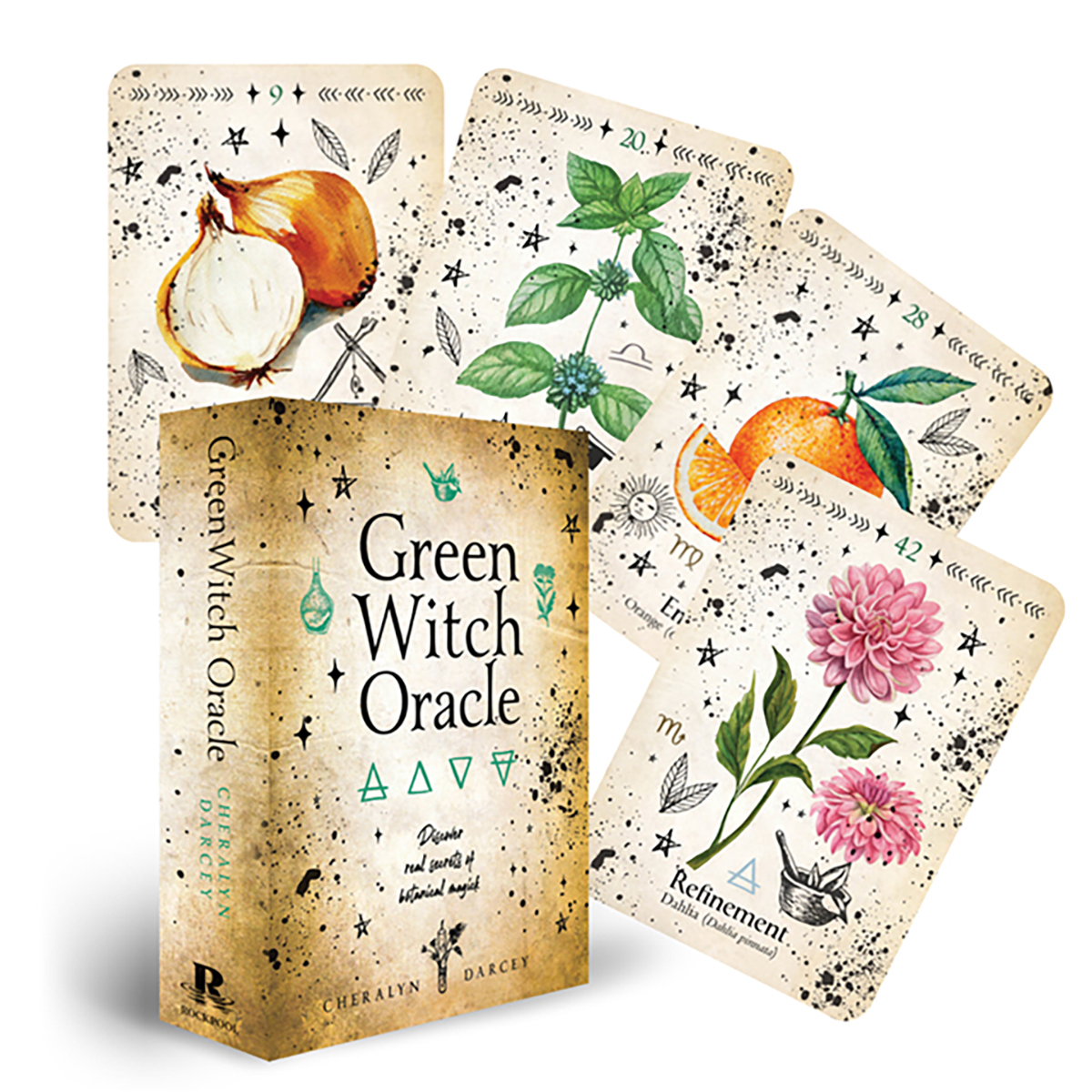

Green Witch Oracle by Cheralyn Darcey
$27.45
Garden Herbs As Oracle
A 44-card oracle of herbs, plants and flowers with their folklore and uses, kept by witches who build spells straight from the garden.
Quick Uses
- Herb Choice: Draw a card to decide which herb to add to a spell, bath or sachet.
- Garden Lore: Read the guidebook’s plant folklore as a quick reference while you work.
- Spell Prompts: Use the spells in the guidebook as starting points for your own.
- Daily Plant: Draw one card a day and spend a moment with that plant if you can find it.
How to Use It
Witchcraft & Folk Magick
- Draw a card before mixing a herbal sachet and add the plant it shows.
- Lay the card for a protective herb under your doormat or above the door.
Hoodoo & Rootwork
- Use the card to choose the herb for a floor wash or spiritual bath.
- Keep a drawn card in a mojo bag with the dried herb it names.
Demonology & Black Magick
- Draw to choose which plant to offer a spirit, then read again to see if it was welcomed.
- Use a baneful plant card as the focal image for a curse, laid under a black candle with that herb.
- Read the doctrine of signatures meanings to match a plant to a spirit’s nature before an evocation.
A Simple Working
- Light a green chime candle and set out a small dish of dried lavender.
- Shuffle and ask, “Which plant ally do I need now?”
- Draw one card and read its folklore and meaning in the guidebook.
- If you have the herb, add a pinch to the dish; if not, write its name on a slip of paper.
- Fold the herb or paper into a small cloth bundle and tie it shut.
- Carry the bundle for a week and note what changes.
Pairs Well With
- Lavender: a gentle cleansing herb for sachets and baths.
- Muslin bags: for carrying the herb a card points you to.
- Mortar and pestle: for grinding the herbs the deck suggests.
- Herbal grimoire: for recording which cards came up and what you made.
What You Receive
One oracle deck of 44 cards with a guidebook including plant folklore, historical ethnobotany notes, gardening advice and spells.
Origin & Lore
Oracle decks have no fixed structure; each is built around a theme. Here the theme is the witch’s garden, and each card is a herb, plant or flower read through its folklore and traditional uses.
The meanings follow the old doctrine of signatures, the belief that a plant’s shape, colour or habit reveals what it is good for, a principle that ran through European herbalism for centuries.
Did You Know?
The doctrine of signatures was set out by Paracelsus in the sixteenth century and given its name by the mystic Jakob Böhme in his book Signatura Rerum, published in 1621.
| Weight | 0.9 lbs |
|---|
Related products

Crystal Balls