
Grey Star Neck Athame (6 1/2″)
$19.75
A ritual blade you can wear close to the body
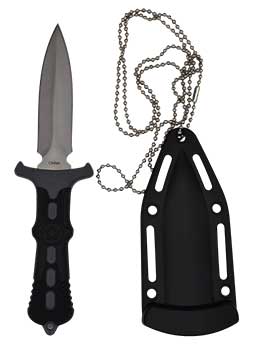
A compact grey star neck athame with a sheath and chain, made for the practitioner who keeps the blade on their person.
Quick uses
- Circle casting: draw the boundary of your circle with the point.
- Warding: wear it on its chain as a guardian blade.
- Travel: a small working blade for rituals away from home.
How to Use It
Witchcraft & Folk Magick
- The athame is the witch’s ritual knife, used to direct energy rather than to cut: it casts and closes the circle, calls the quarters and charges what it points at.
- A neck athame is worn on the body, so it becomes a personal guardian; many witches consecrate it once and keep it on through the day of a working.
- Point it at salt and water and speak over them to make a quick consecrated wash.
Ceremonial & Occult Magick
- In ceremonial practice the blade is a tool of Fire and of will, used to trace banishing pentagrams and to command.
- Trace the Lesser Banishing Ritual of the Pentagram with the point before and after any operation.
Demonology & Black Magick
- In goetic and black magick work the blade is a sign of authority: it is held during the conjuration and pointed at the triangle to keep the spirit within bounds.
- Some practitioners use a worn athame as a guardian against unwanted spirits on the walk home from a crossroads or cemetery working.
A Simple Working
- Pass the blade through incense smoke, a candle flame, a sprinkle of water and a pinch of salt.
- Hold it to your heart and name it as your tool of the art.
- Cast a circle with the point, walking clockwise.
- Do your work, then close the circle anticlockwise.
- Return the blade to its sheath and wear it on its chain.
Pairs Well With
- Altar Pentacle: the earth tool that pairs with the blade.
- Chalice: for the symbolic Great Rite of blade and cup.
- Consecration Oil: to anoint the blade before first use.
- Black Salt: to lay a warding line the blade can seal.
- Frankincense: for cleansing the athame in smoke.
What You Receive
One grey star neck knife, approximately 6.5″ long, with a rubber and ABS handle and a hard plastic sheath on a chain.
Origin & Lore
The athame takes its place in modern witchcraft from Gerald Gardner’s Wicca, where it is the chief tool of the witch, traditionally black-handled.
Its roots run back to grimoires such as the Key of Solomon, which describes knives made and consecrated for drawing the circle and for ritual work.
Did You Know?
In Samuel Liddell MacGregor Mathers’ 1888 translation of the Key of Solomon, the ritual knife is spelled ‘Arthame’, a likely source of the modern word athame.
Related products