

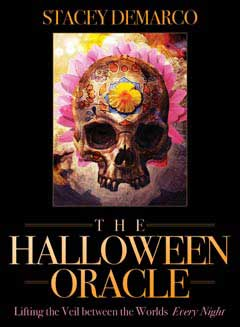
Halloween Oracle by Stacey Demarco
$27.45
Samhain Divination All Year
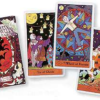
A 36-card oracle of black cats, witches, skeletons and Day of the Dead figures, made for readers who want Samhain’s thin veil on the table every night.
Quick Uses
- Samhain Reading: Draw a card for each person at your Samhain table and read for the year ahead.
- Ancestor Contact: Ask a beloved dead relative to answer through one card at their altar.
- Year-Round Veil Work: Read on any dark night when you want the mood of Halloween.
- Protection Card: Set a guardian card, such as the black cat, in a window as a ward.
How to Use It
Witchcraft & Folk Magick
- Read at Samhain and on the dark moon, when the veil is traditionally thinnest.
- Lay a jack-o’-lantern or black cat card on a windowsill as a household guardian.
Hoodoo & Rootwork
- Place a drawn card on an ancestor altar with a glass of water and a white candle.
- Use a protective card inside a doorway packet with salt and red pepper.
Demonology & Black Magick
- Read before and after a necromantic rite to ask who has come forward and what they want.
- Ask the dead to choose a card in answer to a question, and record the reply with the offering made.
- Use a skeleton or zombie card as the focal image of a curse worked with graveyard dirt.
A Simple Working
- After dark, set a white candle and a glass of water on a small table for the dead.
- Add a photo or a written name of an ancestor you wish to hear from.
- Burn a little rosemary for remembrance.
- Shuffle and ask your question, then draw one card.
- Read it as their reply, using the book for detail if needed.
- Thank them, leave the water overnight, and pour it outside in the morning.
Pairs Well With
- Rosemary: the traditional herb of remembrance for ancestor work.
- White taper candles: for an ancestor vigil.
- Graveyard dirt: for stronger necromantic readings and workings.
- Marigold petals: the Day of the Dead flower used to guide spirits home.
What You Receive
One oracle deck of 36 cards with an 80-page book. Card stack is 5 1/2″ x 3 3/4″ x 5/8″.
Origin & Lore
Oracle cards follow no set structure; each deck is built around its own theme. This one is built around Halloween and its roots in Samhain, the Gaelic festival at summer’s end when the boundary between the living and the dead was held to be thinnest and divination was a common part of the night.
The deck also draws on the Mexican Day of the Dead, including the figure the creator calls Lady de los Muertos and the candy skulls of the festival, which descends in part from the Aztec cult of Mictecacihuatl, Lady of the Dead.
Did You Know?
The Coligny calendar, a bronze Gaulish calendar found in France in 1897, marks a month called SAMONI, widely taken as an early relative of the name Samhain.
| Weight | 0.9 lbs |
|---|
Related products


Crystal Balls