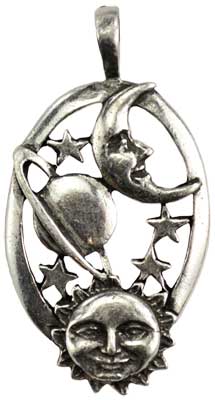

Harmonious Universe Celestial Amulet
$12.05
The Heavens in One Circle
A pewter amulet gathering the sun, moon, planets and stars in one circle, worn by those who look to the balance of the cosmos for peace.
Quick Uses
- Balance Charm: Wear it when life feels out of step and you want to move with the heavens again.
- Astrology Focus: Hold it as you cast or read a chart.
- Peaceful Home: Hang it in the main room of your house as a sign of order and calm.
How to Use It
Witchcraft & Folk Magick
- Charge it under the open night sky and wear it for peace with the turning of the seasons.
- Set it on the household altar with a white candle to bring harmony between family members.
Hoodoo & Rootwork
- Lay it on a petition for a peaceful home and burn a blue candle on it each Monday.
- Wash it in a peace water and hang it over the doorway of the room where arguments start.
Ceremonial & Occult Magick
- Use it as a focus for the seven classical planets, touching each in turn as you say their names.
- Wear it when working planetary days and hours, as a reminder of the spheres you move through.
Demonology & Black Magick
- Wear it when you call planetary spirits and intelligences, as a seal of the heavens they belong to.
- Set it beside a spirit’s sigil to work with them in their proper planetary hour.
A Simple Working
- On a clear night, step outside or sit by a window where you can see stars.
- Light a white candle and a blue candle.
- Hold the amulet and name the sun, the moon and each planet you can recall.
- Ask that your life move with the same balance as the heavens.
- Name one place in your home or life that needs peace.
- Wear the amulet and carry that peace into the next day.
Pairs Well With
- Blue Candles: For peace and calm.
- Planetary Hours Chart: For timing work by the heavens.
- Lapis Lazuli: A stone of the starry sky.
- Astrology Ephemeris: For following the planets.
What You Receive
One pewter Harmonious Universe celestial amulet on a cord, 1 1/2″ x 1″. Made in the USA.
Origin & Lore
Amulets of the heavens were made to align the wearer with the order of the cosmos, the idea that the sky moves in harmony and life on earth can follow it.
The Pythagoreans taught that the sun, moon and planets make a music of the spheres as they move. Johannes Kepler took up the idea in his 1619 book Harmonices Mundi, The Harmony of the World, where he also set out his third law of planetary motion.
Did You Know?
Kepler wrote out short musical phrases for each planet in Harmonices Mundi, based on the changing speed of its orbit.
Related products