



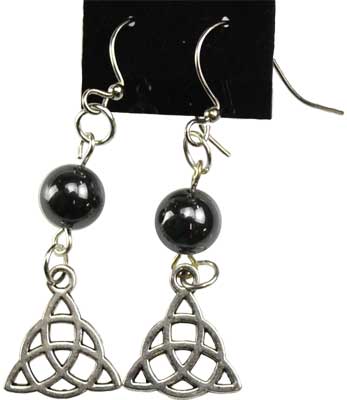

Hematite Triquetra Earrings
$8.75
Iron And The Threefold Knot
Polished hematite beads under a pewter triquetra, worn by practitioners who want an iron-bearing stone and a closed, unbroken knot guarding the head and ears.
Quick Uses
- Ward the Ears: Wear them into any room where gossip or ill-wishing is likely, letting the iron stone deflect what is said against you.
- Court Day: Put them on the morning of a hearing or hard meeting and touch each knot before you speak.
- Grounding After Ritual: Hold the pair in your palm after heavy work until you feel settled back in the body.
How to Use It
Witchcraft & Folk Magick
- Pass the earrings through juniper or rosemary smoke on a Tuesday, Mars’ day, before first wearing them as a ward.
- Trace the triquetra with a finger while naming the three things you want protected: body, home and name.
Hoodoo & Rootwork
- Lay the pair on a court case petition dressed with a little oil overnight, then wear them to the hearing.
- Tuck them beside a protection packet on your altar when not worn, so the charm and the stone stay working together.
Ceremonial & Occult Magick
- Wear them during a Lesser Banishing Ritual of the Pentagram as a personal anchor of iron and enclosure.
- Consecrate them in a planetary hour of Mars with a red candle and a short invocation of martial strength.
Demonology & Black Magick
- Wear them as a guard while evoking, so the iron sits close to the head while the spirit is in the triangle.
- Set them on the seal of a spirit you are binding during the operation, then remove them when the work is closed.
A Simple Working
- On a Tuesday, light a red chime candle.
- Pass the earrings through the flame’s heat three times, once for each loop of the knot.
- Say: “Three times bound, no harm comes round.”
- Sprinkle a pinch of black salt in a ring around the candle.
- Let the candle burn down with the earrings inside the ring.
- Wear them the next day and whenever you feel exposed.
Pairs Well With
- Black Salt: Rings the earrings during charging and adds a banishing edge.
- Red Chime Candles: Short Mars-coloured candles for weekly recharging.
- Protection Oil: A touch on the pewter charms renews the ward.
- Black Tourmaline Tumbles: A second warding stone to keep at the door while you wear these.
What You Receive
A pair of earrings on hypoallergenic surgical steel French hooks, each with a 1/4″ hematite bead and a 1/2″ pewter triquetra charm. Overall length 2 1/8″. Materials: Hematite, pewter and surgical steel. Made in USA. Natural stone beads vary slightly in colour and pattern.
Origin & Lore
Hematite is an iron oxide, and its name comes from the Greek for blood, because the stone leaves a red streak and turns water reddish when cut. Pliny the Elder wrote of haematites, and ancient sources tied it to Mars and to warriors.
The triquetra, three interlocking arcs, appears in early medieval Insular art, including the Book of Kells, and on Germanic metalwork. Christian artists later used it for the Trinity, and modern pagans read it as a threefold knot of protection.
Did You Know?
Despite its silver-black polish, hematite is mostly iron oxide and is one of the main ores mined to make iron.
Related products


