



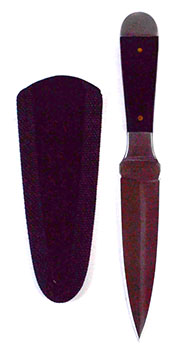
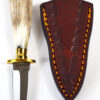
Horn Bosom Athame (6 1/2″)
$25.25
A Small Blade to Keep Close
A compact horn-handled athame sized to carry close to the body, for witches who want their ritual blade within reach at all times.
Quick Uses
- Circle Casting: Point it outward and walk the circle sunwise to cast your sacred space.
- Personal Ward: Carry it with you during outdoor rites as a protective tool.
- Energy Direction: Use it to direct power into a charm or candle.
- Cutting Ties: Slice the air between you and a person to sever an unwanted bond.
How to Use It
Witchcraft & Folk Magick
- Cast your circle with the point held out, seeing a line of light follow the tip.
- Lower the blade into the cup during the symbolic Great Rite at a sabbat.
- Use it to charge a sachet or poppet by touching the point to its heart.
Hoodoo & Rootwork
- Carve names and symbols into candles with the tip before dressing them with oil.
- Draw an X in the air over a person to cut a crossed condition from them.
Ceremonial & Occult Magick
- Trace the pentagrams of the Lesser Banishing Ritual with the point.
- Hold it point up when you call on the archangels at the four quarters.
Demonology & Black Magick
- Draw the circle of protection for an evocation with the point and do not lower it until the spirit has left.
- Touch the blade to a spirit’s sigil while stating the terms of your pact.
A Simple Working
- Choose a waxing moon for a first blessing of the blade.
- Light a red chime candle for strength.
- Pass the athame through the candle’s heat, then through frankincense smoke.
- Sprinkle it with a little salt water.
- Breathe on the blade and say it is now yours alone.
- Hold it over the candle and cast a small circle around your altar.
- Wrap it in black cloth when not in use.
Pairs Well With
- Red Chime Candles: For strength and dedication of a new tool.
- Frankincense Resin: For blessing the blade with smoke.
- Black Altar Cloth: To wrap and protect the athame between rites.
- Chalice: The cup that partners the blade in ritual.
What You Receive
One bosom athame, 6 1/2″, with a horn handle.
Origin & Lore
The athame was first used to cast the circle and command spirits, never to cut anything physical. Its name comes from the arthame of the Key of Solomon, a grimoire that calls for a black-hilted knife in the magician’s toolkit.
Gerald Gardner brought the athame into modern witchcraft in the 1950s, making it the witch’s personal tool of fire or air. Horn handles echo the Horned God, the consort of the Goddess in many traditions of the craft.
Did You Know?
The word athame likely comes from arthame, a term used in a French version of the Key of Solomon.
Related products


