


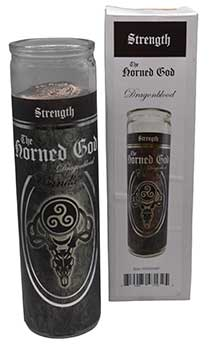
Horned God 90-hour jar candle (dragon’s blood)
$16.45
A guardian flame of the Horned God
A dragon’s blood-scented 90-hour jar candle with Horned God artwork, burned for strength, courage, protection and devotion.
Quick Uses
- Sabbats: burn it at Beltane, Samhain or Yule, the sabbats tied to the god’s birth, union and death.
- Courage: light it before a hard conversation or test and ask for his steadiness.
- Protection: set it at the doorway during the dark half of the year as a guardian light.
- Altar pairing: burn it beside the Goddess candle so both halves of the divine are in the circle.
How to Use It
Witchcraft & Folk Magick
- Sabbat flame: burn it at Beltane, Samhain or Yule, the sabbats most tied to the god’s birth, union and death.
- Courage: light it before a fight you cannot avoid, whether a hard conversation or a test, and ask for his steadiness.
- Protection: set it at the doorway of the house during the dark half of the year as a guardian light.
Ceremonial & Occult Magick
- Altar pairing: burn it alongside the Goddess candle so both halves of the divine are present in the circle.
- Dragon’s blood boost: a pinch of powdered dragon’s blood resin on charcoal beside the candle deepens any work for strength or potency.
A Simple Working
- Set the candle on your altar with a small antler, a pine cone or a sprig of oak beside it.
- Light a disc of charcoal and sprinkle a pinch of dragon’s blood resin on it.
- Light the candle from a match and say what strength or protection you are asking for.
- Pass your hands through the smoke and then over the flame.
- Stand for a moment and picture yourself doing the thing you fear, steadily and without hurry.
- Let the candle burn while the resin smokes, then snuff it and relight on following days.
Pairs Well With
- Dragon’s blood resin: to burn on charcoal alongside the candle.
- The Goddess jar candle: to honour both deities together.
- Pine cones: a traditional emblem of the forest lord for the altar.
- Red jasper: a stone of strength and stamina to keep beside it.
What You Receive
One dragon’s blood-scented jar candle with Horned God artwork, approximately 90 hours of burn time, supplied boxed.
Origin & Lore
The Horned God is the male deity of Wicca and much modern paganism: lord of the forest, the hunt and the beasts, consort of the Goddess and the god of death and rebirth. He gathers older figures into one, among them the Gaulish Cernunnos, the Greek Pan and the English Herne. Dragon’s blood, the deep red resin chosen for the scent here, has long been burned to add power and protection to any working.
The only inscription that gives the antlered god a name was carved in Paris in the first century and found under the choir of Notre-Dame in 1710.
The Pillar of the Boatmen, carved in Lutetia (Paris) under Tiberius, bears an antlered figure labelled Cernunnos. A seated antlered god also appears on the Gundestrup cauldron, found in a Danish bog in 1891. Margaret Murray’s The God of the Witches (1931) argued for a single horned god behind the witch cult, an idea later historians rejected but which shaped Wicca’s Horned God.
Did You Know?
Herne the Hunter first appears in print in Shakespeare’s The Merry Wives of Windsor, as a ghost with “great ragg’d horns” who walks Windsor Forest.
| Weight | 1.8 lbs |
|---|
Related products


