Horned God Statue (12 1/2″)
$82.45
The lord of the wild wood for your altar
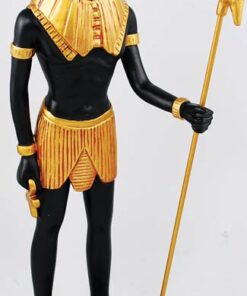
A bronze-coloured polyresin statue of the Horned God, the lord of the forest who protects and loves the Goddess and all her children, standing 12 1/2″ tall.
Quick uses
- Deity work: honour the God at sabbats and esbats.
- Wild magick: anchor forest, animal and hunting magick.
- Balance: stand him beside the Goddess on the altar.
In stock
How to Use It
Witchcraft & Folk Magick
- In modern witchcraft the Horned God is the consort of the Goddess, lord of the wild places, the hunt, life and death.
- Place him on the left of the altar with the Goddess on the right, as many covens do.
- Honour him at Beltane, Lughnasadh and Samhain with offerings of ale, bread and antlers.
Pagan & Celtic Magick
- Call on him as Cernunnos, Herne or Pan in workings of fertility, strength and the forest.
- Leave an offering before the statue when you go walking in the woods.
Ceremonial & Occult Magick
- Use the statue as a telesmatic image, consecrated and invited to become a home for the god’s presence.
- Set it at the north of the temple as the guardian of earth and of the deep forest.
Demonology & Black Magick
- Keep him as the guardian of your temple during evocation, a power of the wild that stands with you.
- Give him an offering before you call other horned or chthonic spirits, so the lord of the wild stands as witness to the work.
- Lay hexing and protective sigils at his feet to charge them with primal strength.
- Call on him in his role as lord of death and the hunt when working with spirits of the underworld.
A Simple Working
- Set the statue on your altar, facing the room.
- Light a green or brown candle and some pine or musk incense.
- Pour an offering of ale or wine before him.
- Call him by the name you know him by and ask for his strength and protection.
- Leave the offering overnight and pour it out on the earth in the morning.
Pairs Well With
- Goddess statue: to stand beside him.
- Green candles: for the forest.
- Pine incense: the scent of the woods.
- Antlers: a sacred offering.
- Wicca Power amulet: the Goddess within the moon.
What You Receive
One bronze-coloured polyresin Horned God statue, 4 3/4″ x 4 3/4″ x 12 1/2″.
Origin & Lore
Horned gods appear in many ancient cultures, from the Celtic Cernunnos to the Greek Pan.
In the 20th century, the Horned God became central to Wicca and modern witchcraft as the consort of the Goddess.
Did You Know?
The oldest known inscription naming Cernunnos is on the Pillar of the Boatmen, carved in the 1st century AD and found beneath Notre-Dame de Paris in 1710.
| Weight | 5.90 lbs |
|---|
Related products