


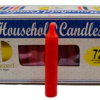

Household candles, 6″
Price range: $1.65 through $46.15
One of our most popular candles · Available in 26 sizes
A plain 6 inch household candle made for long burns, multi-day spellwork, novenas and altar work.
Quick Uses
- Seven days: mark the candle into seven sections and burn one each day for a seven-day working.
- Altar: burn a white household candle on the altar during sabbats and esbats.
- Banishing: burn a black candle on the waning moon for release and banishing.
- Novenas: light a white or coloured candle before a saint’s image during a novena.
How to Use It
Hoodoo & Rootwork
- Mark the candle into seven sections and burn one each day for a seven-day working.
- Dress with a condition oil and roll in herbs for longer money, love or protection workings.
- Set several candles around a petition, burning them down together over the course of a night.
Witchcraft & Folk Magick
- Burn a white household candle on the altar during sabbats and esbats.
- Use a black candle for release and banishing, burned on the waning moon.
Folk Catholicism & Spiritism
- Light a white or coloured candle before a saint’s image during a novena.
- Keep a candle blessed at Candlemas to light in times of storm or danger.
A Simple Working
- Choose a 6″ household candle in the colour of your aim.
- Use a pin to mark it into seven equal sections.
- Dress it with a suitable oil, toward you to draw or away to banish.
- Set a petition paper underneath the holder.
- Light it, state your aim, and let it burn down one section.
- Snuff it and repeat each day until the candle is finished.
Pairs Well With
- A taper candle holder: to fit the 3/4″ base.
- Condition oils: for dressing.
- Parchment paper: for petitions.
- A carving pin: for marking sections and names.
What You Receive
Household candles, 6″ x 3/4″. Available singly in black, white, red, pink, purple, blue, green, yellow, orange and brown; in sets of 6 in red, pink, purple, blue, green, yellow and orange; and in sets of 36 in black, red, pink, purple, blue, green, yellow, orange and brown.
Origin & Lore
Household candles are plain, sturdy tapers made for everyday light, emergencies and the dinner table. They burn far longer than a chime candle, so they suit workings that run over hours or are burned a little each day. In folk magick and hoodoo, coloured household candles are dressed and carved just like spell candles.
Before electric light, a supply of plain candles in the cupboard was as basic as bread, and a candle blessed in church was kept to light during storms.
On Candlemas, 2 February, churches have long blessed the year’s candles, and in many parts of Europe these blessed candles were taken home to be lit during thunderstorms or at a deathbed. Paraffin wax, refined from petroleum in the mid-nineteenth century, made candles cheap enough for every home, and the plain household candle followed.
Did You Know?
Auctions “by the candle” were once common: bidding stayed open until an inch of candle burned out, and Samuel Pepys described one in his diary in 1660.
| Weight | N/A |
|---|---|
| Option | Black, single, Black, set of 36, White, single, Red, single, Red, set of 6, Red, set of 36, Pink, single, Pink, set of 6, Pink, set of 36, Purple, single, Purple, set of 6, Purple, set of 36, Blue, single, Blue, set of 6, Blue, set of 36, Green, single, Green, set of 6, Green, set of 36, Yellow, single, Yellow, set of 6, Yellow, set of 36, Orange, single, Orange, set of 6, Orange, set of 36, Brown, single, Brown, set of 36 |
Related products


