



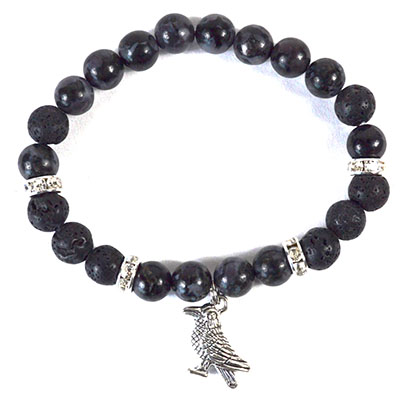

Indigo Gabbro & Lava Bead Bracelet with Raven Charm (8mm)
$13.15
Raven Stone For Steady Nerve
Dark indigo gabbro and porous lava beads finished with a raven charm, worn by witches who want grounding and nerve when the work gets heavy.
Quick Uses
- Courage Charm: Wear it on your left wrist before a hard conversation or a difficult rite.
- Oil Carrier: Rub one drop of your chosen oil into the lava beads each morning.
- Raven Call: Touch the raven charm and speak your question before a reading.
How to Use It
Witchcraft & Folk Magick
- Dab the lava beads with a protection oil on a Saturday and wear the bracelet through the week as a carried ward.
- Lay it on your altar beside a black feather when you ask for messages from the crossroads or the wild.
Ceremonial & Occult Magick
- Wear it during Odinic or Norse workings, letting the raven stand for Huginn and Muninn, thought and memory.
- Hold it in your receptive hand during scrying to keep your body grounded while your sight goes out.
Demonology & Black Magick
- Anoint the lava with a drop of the oil you use for a particular spirit, so the bracelet carries that spirit’s scent into the rite.
- Wear it during banishings and difficult evocations as a grounding piece that keeps you rooted in your own body.
A Simple Working
- On a Saturday night, light a black chime candle.
- Burn a little myrrh resin on charcoal beside it.
- Pass the bracelet through the smoke three times.
- Rub one drop of protection oil into the lava beads.
- Hold the raven charm and name the challenge you are facing.
- Let the candle burn down and wear the bracelet the next day.
Pairs Well With
- Black Chime Candles: For grounding and protection work.
- Myrrh Resin: A traditional smoke for cleansing and consecrating charms.
- Protection Oil: To charge the porous lava beads.
- Raven Feather: To sit beside it on a Norse or crossroads altar.
What You Receive
One elastic beaded bracelet of 8mm indigo gabbro and lava stone beads, adorned with a raven charm. Natural stones vary in colour and pattern.
Origin & Lore
Indigo gabbro is a dark, speckled igneous stone sold in the crystal trade under names such as mystic merlinite. Lava beads are shaped from porous volcanic basalt, and their open pores are why practitioners use them to hold oils.
The raven is one of the oldest omen birds of the north. In Norse myth two ravens, Huginn and Muninn, fly over the world each day and return to tell Odin what they have seen. Ravens were also read as battle omens and messengers between the living and the dead.
Did You Know?
Gabbro takes its name from Gabbro, a village in Tuscany, Italy; the term was introduced by the geologist Leopold von Buch in the early nineteenth century.
Related products


