

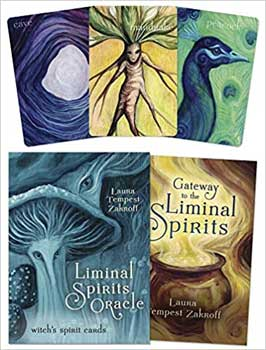
Liminal Spirits Oracle: Witch’s Spirit Cards by Laura Tempest Zakroff
$27.49
Oracle For Spirit Contact
A 42-card oracle by Laura Tempest Zakroff for divination, spellcraft and communing with liminal spirits, used by witches who work at the boundaries.
Quick Uses
- Spirit Communion: Draw a card to meet the liminal spirit of the moment and greet it.
- Spellcraft: Lay a card on the altar as the guiding spirit of a working.
- Divination: Read a short spread for guidance in times of change.
- Meditation: Use one card as a focus for quiet trance work.
How to Use It
Witchcraft & Folk Magick
- Read at boundary times: dawn, dusk, midnight, and the turning of the seasons.
- Set a card at a threshold, doorway or crossroads as the guardian of a spell.
Ceremonial & Occult Magick
- Use cards as sigil-like focuses: gaze at the art until it fixes in the mind, then let it go.
- Draw a card to set the tone of a ritual before casting the circle.
Demonology & Black Magick
- Ask the spirit a card represents to answer questions through further draws, and keep a record of each contact.
- Read before and after a necromantic or evocatory working to confirm who is present.
- Use a card as the focal image of a pact or offering working with a boundary spirit.
A Simple Working
- At dusk, stand at a doorway or threshold with the deck and a black chime candle.
- Light the candle and burn a little mugwort.
- Shuffle and ask which spirit of the threshold will speak with you.
- Draw one card and greet the spirit it shows by name.
- Ask one question and draw a second card for its answer.
- Leave a small offering, such as a coin or a splash of wine, at the threshold and thank the spirit.
Pairs Well With
- Mugwort: a traditional herb for trance and spirit contact.
- Black chime candles: for threshold and dusk workings.
- Offering dish: for gifts to spirits contacted through the cards.
- Spirit journal: for logging which spirits came forward and what they said.
What You Receive
One oracle deck of 42 cards with a full-colour guidebook, in a package of 6.6 x 1.6 x 4.9 inches.
Origin & Lore
Oracle decks have no fixed structure, so each is built around a theme. This deck is built around liminal spirits, the beings of thresholds and in-between places, and is meant to serve as a divination system, a spellcraft tool, a means of spirit communion and a focus for meditation.
Its art is by Laura Tempest Zakroff, author of Weave the Liminal and Sigil Witchery, whose work centres on the witch as a walker between worlds.
Did You Know?
The modern sigil method many witches use comes largely from the English artist Austin Osman Spare, who described it in The Book of Pleasure, published in 1913.
| Weight | 1.2 lbs |
|---|
Related products