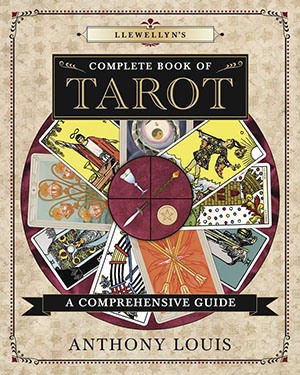
Llewellyn Complete Book of Tarot by Anthony Louis
$28.59
The whole tarot tradition between two covers
Anthony Louis’s comprehensive guide to tarot history, meanings, spreads, reversals and the Marseilles, Rider-Waite and Thoth systems.
Quick uses
- Study: learn card meanings, reversals and dignities.
- Spreads: try specialised spreads for focused questions.
- Correspondence: link the cards to astrology, Kabbalah and numerology.
How to Use It
Divination & Spirit Work
- Tarot began as a card game and became an instrument of divination in eighteenth-century France; today readers use it for insight, spirit communication and fortunetelling. Work through this book one suit at a time and draw a daily card to fix each meaning in memory.
- Use its spreads for specific questions and keep a reading journal to compare outcomes with the cards.
Ceremonial & Occult Magick
- Golden Dawn and Thoth readers treat the Major Arcana as paths on the Tree of Life; use the Kabbalah and astrology chapters to deepen pathworking and meditation.
- Choose a trump as a talisman image for a working and meditate on it daily.
Witchcraft & Folk Magick
- Draw a card before spellwork to see where your working stands, and another after to read its course.
A Simple Working
- Shuffle your deck while holding your question in mind.
- Lay out a spread from the book.
- Read each position using the book’s meanings and correspondences.
- Note the astrological and numerical links that stand out.
- Record the reading and revisit it in a month.
Pairs Well With
- A tarot deck: Marseilles, Rider-Waite or Thoth style to read with the book.
- Reading cloth: to lay out spreads on a dedicated surface.
- Amethyst or clear quartz: kept with the deck for psychic work.
- Divination incense: to open a reading session.
- Tarot journal: to track readings over time.
What You Receive
An 8.03″ x 10″ paperback book with 336 pages by Anthony Louis.
Origin & Lore
Anthony Louis explores tarot history, card meanings, spreads and reading techniques across the Marseilles, Rider-Waite and Thoth systems. The book covers associations, correspondences, reversals and dignities, and the links between tarot, astrology, Kabbalah, numerology, Jungian psychology, journaling and storytelling, as well as card selection, creativity and tarot ethics.
Louis is a psychiatrist and long-time tarot and astrology author.
Did You Know?
The Rider-Waite deck was illustrated by Pamela Colman Smith under the direction of A. E. Waite and first published in 1909.
Related products